More than Service with a Smile

A long time ago in a galaxy far away, when Wright and Rede was still just a twinkle in my eye, I read a fair amount of business planning books. There is one that still sticks with me to this day. It contained, by far, the worst piece of business advice I have ever read. The book was one of those you-will-write-a-business-plan-while-you-read-this-book books. Part of the writing process involved supplying the name of your CFO, attorney, and accountant. The author then went on to proclaim "If you can't afford to pay people to fill these rolls then you can't afford to start a business." You know what I did? I finished reading that book and took notes. I often refer back to these notes when I am trying to decide how to not run my business. I wish I had written down the title of this opus so I could contact the author and tell him what an asshat he is, but justice cannot always prevail. That being said there are three things that you really must have in order to have a successful business. A solution to a problem, a strong message (back story, motivation, good images), and excellent customer service. I'll talk about the first two in later posts but, having experienced some lousy customer service today, I think I'll go ahead and address it before all the steam finishes venting from my ears.

Customer service is not about dealing with customers that have a problem. It is not a skill you use only when something goes wrong. Look at those two words. It is the way you provide service to your customers. The fact of the matter is that unless you are selling the cure for cancer (and the only one selling it) people have a choice to buy from you or not.

Have you ever been to a hot new restaurant where the staff thinks they are God's gift to the service industry? Maybe they were wearing ripped jeans, too much pomade,rolled their eyes because you didn't realize the draft list was written on a postage stamp by the front door,  and were looking down their nose at you because you didn't want to try the fried eel testicle appetizer? I don't care how good those eel's nuts might have been, I'm not going back. This doesn't just apply to the restaurant industry. No one wants to hire an electrician that doesn't show up to work. They won't donate to a charity that can't get their name right. Time Warner Cable. Seriously, Time Warner Cable.

I think this problem is so endemic because it is so hard to scale and requires such a huge investment. It is an invisible investment too. If you own a shoe company, and spend a ton on R&D for a new shoe design, when you are done you have a new pair of shoes. When you spend a ton of effort on customer service you end up with a bunch of people who are willing to continue to do business with you. Which is why so many companies are huge one minute and forgotten the next. If you can't do customer service right then you have a steadily shrinking pool of available customers who are willing to do business with you. No matter how tasty your eel testes are.

So what should customer service look like? Do you have any regular customers? Do you know their names? Do you ever find yourself saying, "Hi Randy (or Rick, Lori, Walter, Frank, Phoebe, Joe, Troy, Brian, Jesse or Nathan)" Do you know what is going on in their lives? Do you care? Because that is what real customer service looks like. A failure in this arena isn't that you couldn't provide something they were looking for and don't get a sale. A failure is when you start to treat them like a number. The customer isn't always right. Sometimes you just don't have what they are looking for or your business doesn't provide a service that they need right now. That is fine. If you are doing your job right they will come back later.

Because ultimately, until our iPhones rise up and become our automaton overseers, customer service is about people. I know that sounds like some crap the manager at your first job shoveled at you, but it is true. When you start to see your customers as people (people who are willing to part with the money that they worked hard to earn, people who are trusting you to do your job right, people who are willing to let you occupy some tiny part of their lives) then you are starting to provide some real service to your customers.

So where to start? If someone asks for your business card (or about your business), shake their hand and tell them your name. Hopefully you will get theirs in return. Remember their name. Write it down if you have to. Get to know them. I do this using normal human means of communication such as "How are you doing?" Go through the trouble of remembering what they say.

Avoid giving canned answers. Yes, if you meet a bunch of people in a day you will start repeating yourself. To avoid this, think about the words that are coming out of your mouth.  I know this guy who sells pies at a local market. He is the master of canned answers. He has one for every situation. I occasionally buy a pie from him. If he weren't there I'd buy a pie from someone else. Because he is just some guy that sells pie. I know another guy named Hunter. He sells almond milk at the same market. When I first met Hunter he shook my hand and asked about my business. We have since talked about owning our own businesses. When he isn't at a market I'll check his Facebook page to see where he will be selling next.  I've known Hunter for years. I've watched his business grow. We have had beers together. I give a shit. See the difference?

In the same vein, never use a form letter. Nothing pisses me off more than a form letter. Take the time to use real human thoughts when writing an email. Your customers can tell the difference. I don't care if you have answered the same question a thousand times before. Put it on your F.A.Q. then, but take the time to give everyone a little consideration. There is no short cut for customer service. Expect to invest one third of your effort in it. There is no way to become more efficient at it. By it's very nature it is an investment of time and consideration.

It's okay to tell someone "no". This is a hard one. If you aren't the right person for the job you are doing your customer a disservice (and abusing their trust) by telling them you can do something that you can't. When you tell them "no" use real human thoughts while doing so. See above. Also, always offer a real explanation as to why. They don't need the gory details of your life but explain, for example, that the type of material you use wouldn't work well for the job. They'll come back when they need something you do offer.

If you have to hire employees that will be interacting with your customers take the time to educate them properly. That way they can give intelligent answers to peoples questions. The worst thing you can do is tell an employee that there is always one right answer to a question. I take that back, the worst thing you can do is give them a script. It's demeaning to your employee and your customer. Train your employees to act like humans.

Finally, always remember that you are a real human being interacting with other real human beings. Treat them the way you would want to be treated. Give them your attention. When you start doing that you  stop having customers. You have people that will help hold your event tent down in a thunderstorm, recommend you to a shop that could carry your goods, cheer you on when business is hard, tell you that they'll wait until you are happy with your bag design to buy one (instead of buying from someone else), be your ambassadors, your marketing department, bring you a beer after a long show, and proudly tell people that they knew you back when and still know you now. Because people, unlike customers, have more to offer than just the cash in their wallet. Customer service is the act of investing in your people. When you invest in your people what they give back is priceless.


The Poverty of Inspiration and the Richness of Want

There comes this strange time in the growth of a business. You have hit your stride. You are building momentum. Things are starting to make sense. The time has come to grow but you can't because the resources you have available do not match up to the need in your vision. When your side gig becomes your main squeeze there is no extra income. Every dollar I make I have to decide, is this dollar for me or does it go to the business? A growing business is a hungry baby and a good business is always growing. While I find this unimaginably frustrating, I have also come to see this as a boon. Bootstrapping is a cerebral art. There are never any easy answers. When you learn how to make do with what you have you distill what you are capable of. When there are no obvious solutions you are forced to come up with more unique answers. Answers that only you could have arrived at. A strong business is built with novel solutions rather than just following the well traveled path before it.

I can't begin to tell you how many times I've decided that I needed to buy a new piece of equipment in order to get something to work. Then I've gone on and figured out a better way to get by without it.

Here is a real life example. I'm ready to start producing bags. I've spent the time designing them. I've built the perfect bag in my head. I made a prototype. It works the way I wanted it to. When I tried to get them into production I discovered that hand-stitching the way I was hoping to do was not going to be feasible. I came to the obvious conclusion. I will have to buy an industrial sewing machine. But honestly, the money I'd have to spend on one could be used in a million different ways. A growing business is a hungry business. That also doesn't account for the investment of time and patience required to master the thing. Not to mention a machine stitched seam is not nearly as strong as one done by hand. So my lack of available resources has driven me to abandon that design and try to come up with a more novel approach.

I started to redesign the bag with no stitching. While I'd like to claim this concept as my own, I have to give credit to some of the forebears of leather working. Machined thread is a newer creation and stitchless bags are an old design. I had passed on this idea a long time ago because all the versions I've ever seen of it were really poorly made. In my head stitchless bag equals shoddy craftsmanship. With industrial scale stitching out of the question I took another look at the design. I began to see ways to improve it. I began to see how easy it would be to repair over time. How nice of a shape it makes when it comes together. How it makes a stronger seem than one that is stitched. So now I have a better bag. I truly feel that it is a much better design than what I was trying to push into production before. More importantly it is held together by a bunch of novel little solutions I was forced to come up with. Little novel solutions that will make the design my own. If I had the resources that I wanted I'd be machine stitching bags at this very moment. Yes I'd have a finished product, but it probably wouldn't be very interesting. I'd have spent all that time and money to create something just like everyone else.

So next time you feel the like the only way to grow your business is to make a big investment take time to decide what type of investment you are going to make. Are you going to throw some money at it for a quick fix or can you tap into the resources you already have and come up with something better? Sometimes the really valuable answer requires an investment that you must make of yourself.

An Honest and Open Accounting of My Second Year in Business.

Somewhere around November 6th of last year I hit the two year mark for Wright and Rede. Only I didn't notice and I'm just now realizing that I never did my end of the year round up. I think that is a good example of what this second year in business has been like. The first year of starting a business is all about moments. The series of firsts that keep driving you on to the next milestone. The second year is a steady slog uphill. Not that I don't like the slog. I love the slog. I eat slog every morning for breakfast and love it. Slog is what makes you feel like you are starting to get a grip on what you are doing. Slog puts a little ground under your feet for the first time. It's also kind of sloggy. What use to be a major milestone last year is just another task to be completed this year.

The second year heralds just a little bit of normalcy. I have a general idea that I can actually make a living doing this. I have a reasonable grip on how much work it is going to take and how much material I need to have on hand. The days of stumbling around in the dark are fewer but strangely missed.

I had some hard lessons learned and a few roads blocked. In 2014 I decided to stop seeking out wholesale business. After sitting down and doing a little math and some serious soul searching I had to conclude that my work is too labor intensive to sell at wholesale prices. Maybe someday I'll be able to produce enough that it is an option again. Right now it is just noise that is distracting me from the work that needs to get done. In April I pulled out of my last consignment shop as well for the same reason.

I also succeeded in having my first truly public failure. I spent six months promising and promoting messenger bags that would be ready for the holidays. Then the holidays arrived and I discovered that hand stitching bags at a production level is a superhuman task no matter how many extra hours I throw at it. I had to come to the conclusion that for the amount of labor I put into each bag, I'd have to charge a price that I didn't feel they were worth.

There were some great moments in 2014 as well. The good folks at Cleveland Magazine were kind enough to put a nice big picture of my goofy mug in their publication. The article that went along with it made my mom proud and (hopefully) everyone who ever picked on me in high school green with envy and self-doubt. There was the morning I woke up to discover that my website had sold out over night. There was that weekend where I sold an entire season's worth of stuff in three days. There were all the people I had to apologize to when they came looking for a bag I didn't have who responded with “We can wait.” There were trips to cities I've never been to before. New products were stumbled upon. Things were made and sold. Blood spilled. Tears shed. Acquaintances were turned into friendships over pints of beer. Burdens were lightened and gossip was dished. The second year has fewer milestones but the more I look back on it the more I smile. There is something to be said for the quite happy moments. They might pass by unnoticed but they have added up to a life that I'm happy to live, which is the point of this whole venture anyway.

The biggest (and best) moment waited until after my season was over. He is currently napping right next to me while I (quietly) type. While he was asleep he went from being four weeks old to a five weeker this morning. Nothing has provided more clarity to my life than this little guy. You can gain a lot of confidence when it is required rather than volunteered.

Social Media:

First, before I rattle off some numbers here, the biggest social media milestone is that I stopped giving a flying fig as to how many likes I have received. I have been witness to too many social media juggernauts putting out crappy (and over priced) work to really care any more. The simple reality is this: some people will get me, some will not. I'd rather have 200 people that are really interested in what I'm trying to do than 5000 anonymous followers.

Facebook followers: 360

Instagram followers: 734

Pinterest followers: 101

Tumblr followers: 34

Twitter followers: 185

Mailing List subscribers: 782

What's Up For 2015?

That is the big question. January is always the time of year when I sit down and do all my planning for the year. Mostly I just ask myself if this is the way I want my life to be going and if not what can I do to change it. The little guy is going to change a lot of things. Working from home makes childcare a lot easier. It also makes getting any work done much more complicated. I foresee many late nights in my future. I'm also going to have to scrap a few of my more labor intensive products. While that's a little sad, it's also a chance to try new things. The bags (once again....) are on the drawing table. A new design that requires a lot less stitching but is much stronger is in the works. Hopefully this pony will make it to the finish line this time. A couple of side projects have turned out to be a big success. I hope to spend more time working on special one offs and experimental projects. That is one of the benefits of not courting wholesale accounts. I think the biggest change for 2015 will be in the way I do business. Last year I didn't have a weekend off from April until October because of all the events I do. It's a lot of fun getting to talk to everyone. It's a lot less fun having your livelihood dependent on whether or not it is windy that day. So starting with the website relaunch I did back in October I'll be devoting much more attention to the internet side of my business. Also, I have plans for some interesting collaborations, but that will be a discussion for another day.

Finally I want to take a moment and thank everyone for all of their support in 2014. I was talking about how the milestones fade as the time passes. This past holiday season was one that not only broke records but sent them packing. It is rare that I am left speechless (imagine that), but that is exactly what happened and on more than one occasion. What all your support really means to me is that right now, during my slow season, I can take time off and sit here and watch my son sleep and daydream about what he is going to be like when he grows up instead of worrying about paying bills. It blows my mind that I've gotten myself to the place I am at right now. I could not have done it without all of your support. So thank you.

This will be a hell of a year. Hope to see you out there.

The Great Weathered Leather Experiment Results: Different Strokes for Different Folks


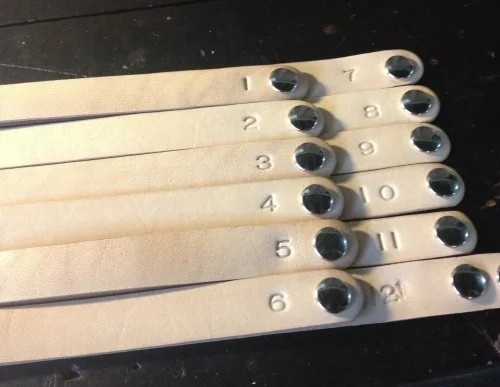
A little over a year ago I had an idea. Give away twelve bracelets to twelve people. The bracelets would be as raw and natural as possible. The instructions were to do what ever you want to it, just take a picture every month and send it to me.

In the following year we have learned a lot. Oil and sun will darken the leather. Oil more so than sun. Some bracelets got zero conditioning. Some were soaked in oil. We learned that natural oils (coconut or olive) worked well. Mineral oil or other petroleum based treatments tended to do some harm in the long run. Natural oils and fats age. Mineral oil breaks down into solvents and destroys the natural fats in the leather. Coffee does not stain leather as much as we thought (or hoped) it would. Chicken poo and grape jelly just add to the character.

Lastly I was able to demonstrate my favorite thing about vegetable tanned leather. Leather is a natural material. It changes and ages just like we all do. As you carry it through the journey of your life, it will carry the story of what you've experienced.  Twelve bracelets all identical, given to twelve people. One year later each one is completely unique. Pretty cool.


While our documentation of this experiment is over the Great Weathered Leather Experiment continues in every item I make. If you are interested in following along, check out the board I've started for Wright and Rede in the Wild on Pinterest.

Cultivate Strength over Momentum.

Starting a business isn't easy. There are no paths to follow. There is no right way to do it. There are plenty of people out there who are more than willing to talk about how they succeeded. Who doesn't want to sit around and talk about their accomplishments?  A few people are willing to talk about the hard parts, mostly in the context of how they overcame them.  Almost no one talks about the day to day struggle of starting or owning a business, mostly because it can be kind of boring and ugly. I also think that in part it is because our brains like to block out the bad parts and only remember the good. It's a defense mechanism. This is why I've taken to writing it all down. For the first year of my business I dutifully wrote down every fear and worry I've struggled with. I'm now well into my second year of being an independent business owner. I have gained a lot of experience and I'm much more comfortable with the risks associated taking the path less taken. I've also learned a very hard truth. The second year is much harder.

Year one is marked with highs and lows. I had lots of sleepless nights because I honestly had no idea what I was doing. There was the first time I disappointed a customer. The first time I got into a really big show. The first account I had to cut ties with. The first time I got mentioned in the paper. The first time I made a dumb call that cost me money. The first time I ran into a stranger who had a friend that bought something off me. The first time I was asked a question I didn't know how to answer.

It's all those firsts that helped get me through it. Even the bad ones were some sort of new horizon. There is a lot of momentum created when everything is new and people hear about you for the first time. All you have to do is stay on top of that momentum; just stay ready for anything.   I've found the second year is all about hard work because the momentum has to come from within me. I think that is why a lot of business don't make it out of the honeymoon phase. At some point you have to stop drawing on the energy from around you and start drawing it from yourself. It's exhausting and it is constant.

I can see now how successful business fail. You keep pouring your energy into it. The bigger you get the more energy you pour into it. Your reserves run low. Something goes wrong, and because this is real life, lots of other little (and usually completely unrelated) things go wrong a long with it. So you reach this weird juxtaposition. Where you've kind of made it to your goal (or at least you are making progress on the path to it) but the part of you inside that was driving you dries up.

Now that I know what to look for I see it constantly. A new business is suddenly everywhere. Their Kickstarter funded. They're getting lots of press. They can't make new stock fast enough. Then the updates start getting farther apart. Then the orders start to get more and more backed up. Then they just walk away and no one understands why. There is this new television show. The plot is great, characters gripping, and the critics love it. Then suddenly two years later they've jumped the shark, quietly get canceled, and no one will ever know the ending (I'm looking at you Heroes). Boy meets girl. They fall in love. They move in together. They annoy the crap out of their friends and disappear into their own little world. Then one day they have nothing to say to each other anymore. They part.

This is the reality of the second year. Sounds horrible right? It's true. There are some moments that can really suck. There are days when it's hard to keep showing up. The dream is still there but it's so hard to keep reaching for it. I'm in one of those moments now. This is why I’m writing this now because later my tricky brain will whitewash over this. I am, however, not willing to walk away.

Fortunately I've learned a few tricks. First, realize that newness is like a steroid. It can build you up quickly and provide a lot of strength, but it is false strength. Real strength comes from within. There is a big difference between the professional athlete that gets carried off the field because of a bad hangnail and the one who finishes the quarter with a broken thumb. One of them is strong and the other was just big.

Cultivate your strength. Sometimes the best way to do this is to walk away. Get some exercise. Go for a run. Hit the gym, hard. Hike in the woods. Play tag. Get away from your work and work your body instead. You'll live a longer and you'll give your mind a break.

Do something unproductive you've never done before. Take a pottery class. Go to a museum and look at art, not because you are looking for inspiration, but because it is freaking beautiful. Drive to a nearby city that has nothing obvious to offer and spend the day exploring. Volunteer somewhere.

Talk to someone that is in the same boat as you but does not love you. This is important. Your friends and family care about you, which is great, but their primary concern will be to make you feel better. Finding a good peer to talk to will give you a good place to vent to someone who actually knows what you are feeling. You'll also probably discover that they are going through the exact same shit as you and for some reason that will make you feel better.

Put down your phone and walk away from your computer. Because the internet is the devil and here to make you feel like you are being productive when really it's just sucking your life away. There are no answers for you on the internet. So stop looking. Strength comes from within. You can't find it on someone's blog (this one included). So put the phone down. Not for an hour. Not all morning. Put it down for as long as it takes. What ever happens while you are not there will be waiting when you get back. Right now it is just sucking up the little bit of energy you got left.

Most importantly I try to remind myself that my life is about more than the business I have created. I'm more than my job. If my business implodes tomorrow I'll still be here. Those reserves I was talking about before are there because of the richness of the life I have lived up to this point. If the life I'm living outside of work is dull and grey then of course the energy I'll have to devote to my work will be lack luster. When I take some time and live a little a can see that my business is just a little part of me.

Will I feel better when I'm done? Will the problems go away? Will the day to day struggles become less of a burden? Nope. What I will have, however, is a new coffee mug, a healthy heart, a new gallery to check out, a greater appreciation for Hudson, Ohio, and the strength to take another step forward. That is what owning a business is really about; finding the strength to take the next step forward.

Fair Weather Followers; Or How I Learned to Stop Worrying and Love Aplomb

As an owner of a small business I've had to learn to tackle the world of social media over the past year. While it is a powerful an effective tool for any fledgeling entrepreneur, I also worry that it is doing as much harm as good. In the interest a clarity I'm going to break this one up into three posts. Here is part One and part Two.

Part Three: Fair Weather Followers; Or How I Learned to Stop Worrying and Love Aplomb

Establishing the real impact and value of your business is important. Especially if it is a business that you have built yourself. If you have poured your heart and soul into a company, and that company is a reflection of your self, you want to know that people value what you have built. If you do any kind of business online this value is almost always measured by a series of customer interactions. This day and age your quality is measured by the number of "likes" (or follows/retweets/shares/upvotes/repins/or favorites) you can bank in a given day. When people try to establish the importance of their venture they might start by saying "I've got 120K followers on my Facebook page." Which sounds impressive. When they speak, over one-hundred thousand people will listen. That's power, right?

This actually reminds me of a phenomena that has started to die out recently. Up until the late nineties when two business persons met at a conference (kind of like the internet but with worse coffee) they might introduce themselves by saying something like:

"Bob Dallas, I own a sprocket factory in Boise that employs over 5000 people."

"Hi Bob, I'm Frank Newhart. I own a cog  franchise with 130 locations in the Tri-State area."

Theses numbers sound impressive when you hear them, but when you really think about what they are saying it's pretty meaningless. Are those 130 locations profitable? Are the 5000 people working for you doing good work? Do they care about their jobs? Take this example:
"Hi, I'm Bob Dallas. I have a company where 5000 people are doing work that could have been done by 1000. We are very inefficient and 4500 of them are just working there while they try to find something better."

A little less impressive, right?  Recently, internet industry gurus have caught on to this problem and have introduced a new set of metrics. It's called "conversions". A conversion basically means, I ask/you do. If I post a message, you share it. If I offer a coupon, you buy something. If I tweet something humorous you favorite it. The iGurus assume this to mean that your customers are engaging you and that all those Follows are adding up to dollars. This is the fundamental idea behind social marketing. It almost makes sense. Until you start to look at comparative analytics.

Analytics are a set of tools that let me see how the conversion process (gee, that sounds kind of menacing) is going. When I say "check out this page" how many people actually do? When I send out an email I can see the percentage of people that opened it (kind-of-but-not-really but that's another story). You can also set some comparative analytics whereby you identify as an industry and you can see how your rates compare to others in your field. That is when the truth really starts to set in. In my industry, an average mailing list blast has an open rate of 24% and a conversion rate of 4%.  That is the rate set by industry leaders that have office buildings full of people who's sole purpose is to figure out ways to get you to click a link. That's pretty weak.

So 120K followers might sound impressive, but when you break it down it's not so great. Of those 120K followers 91K will ignore what you have to say completely. 115K of them will not be willing to use your coupon, click share, or comment on something you've posted.

So enough of the hypotheticals. Let's take a look at my Instagram account. At the time of this post I have 533 followers. Through my extensively insecure, self-doubting research I have concluded that this number is less than companies of equal mass in my field. If I further break that down, using common sense analytics, I can safely assume that  I can subtract a given percentage of those people right off the bat because they will never buy anything from me. These are people who will scroll past my pictures without reading what I wrote. People who are my kinda-friends but don't want to buying anything right now. People who followed me because I followed them.  (I see the follow-for-a-follow technique as the equivalent of bailing water into each others sinking ships.) People who are looking to copy my designs, ideas, or dumb jokes. People who need a little inspiration and are just looking at pretty pictures. People who don't speak my language. People who set up an Instagram account, followed my feed, and then never logged on again. And finally perverts (because any given population on the internet is at least partly kinky weirdos). I feel it's safe to assume that about 10-15% of the people that follow me will actually commit to buying something. Which, according to my analytics account, sets me well above the industry standard. So all that work for about 50 people. Why even bother?

Here is why I bother. Of those 50ish people that are willing to be "converted"  two of them saw a post on Instagram, showed up at one of my events, bought what I had posted, and then hung around (literally) to act as human ballast for my tent while a wicked storm blew in. (You know who you are if you are reading this. Thanks again!). Another one of those 50 people saw something I had posted and drove from Akron to Cleveland (30+ minutes) so that he could pay me in cash and therefore save me the credit card processing fees. Of those 50ish people well over 90% are returning customers (I still use restaurant lingo and call them my regulars). I know this because I know their names and faces.  I've met them. I've engaged in actual human interaction.

Sure, I could inflate my numbers by posting vapid lifestyle photographs in my feed. I could repost unoriginal material because it looks good and will earn me some likes. I could conduct surveys where I don't bother reading the answers so long as I can count a higher number of interactions. I could offer give-aways and gain (and then promptly loose) 100 followers in the hopes that a small percentage will stick around.

I don't though. Not just because it makes me feel cheesy, not because I'd rather be making stuff than posting about it, but because I'm not concerned about growing the percentage of fair weather followers on my feed. I'm more concerned about finding that 10% that will stand around in the rain with me.

My take away from all this. Be honest. Work hard. Make good shit. Of all the people in this world only a small percentage will get what you do. If you focus on staying true to what you do they will find you. Everything else is just noise and worry.


(P.S. Bob Dallas and Frank Newhart are just figments of my imagination and weren't harmed during the making of this post. If you are actually named Bob Dallas or Frank Newhart I'm not writing about you it's merely coincidence, but seriously, you should check out my Pinterest account. You might find something useful there.)


Down the Rabbit Hole: Don't Believe Your Own Hype

As an owner of a small business I've had to learn to tackle the world of social media over the past year. While it is a powerful an effective tool for any fledgeling entrepreneur, I also worry that it is doing as much harm as good. In the interest a clarity I'm going to break this one up into three posts. Part Two: Down the Rabbit Hole;  Don't Believe Your Own Hype

In part one I discussed social media as an alternate reality. The idea being that by continually witnessing a series of notable moments (staged or otherwise) you are hampering your ability to advance your own purpose. In part two I'm going to take this idea a bit further and look at what this alternate reality does when you become part of it.

When you really boil it down social media (and branding in general)  is all hype. You are basically taking your message (look at what I make, I like cats, I'm important, here is something that needs attention in the world, high school was awesome, high school is over...) and putting it out there in the hope that other people will be affected by it (they read it, relate to it, like you more, take action, buy something). There is nothing good or bad about this. As a business person it gives me a unique opportunity to educate people about what I do and why I do it. Obviously, hype can be used negatively. Like how the burgers in fast food advertisements don't look anything like the sad lumps of green/grey proto-meat you get at the pick-up window.  Don't get me started on the negative impact social media is having on our collective self-image.

As I have gotten more into the business of doing business I've started to tackle the hype hurdle. I'm focusing on better pictures, sharable nuggets about my business, packaging, my story and visual identity. Like everything in life, this will be a perpetual work in progress. What I'd like to look at is what happens when you get so caught up in nailing this one aspect of your business that you forget what it is you are doing. I'm going to do this via a real life case study.
The Bandana Bandito (not the actual name of this company BTW)

So I have been following a graphic designer on Instagram for a while. He has started his own line of of screen printed clothing and accessories. His message is one I enjoy. He has a really clean aesthetic. Lots of pictures of campfires, mountain sunrises, old trucks, making things with your hands, and quality old stuff. He got me; I moseyed over to his website. The website is solid too (lots of stories about travel and foreign places, Kinfolk-y pictures) and really well designed. I went to the store and looked over the products. They look pretty cool. I'm a big fan of bandanas (pocket sized functional artwork), so I picked one up.

A few days later the bandana arrives. Again the branding is spot on. The envelope it comes in is custom made, a nice linen bag with custom graphics, a cool looking free sticker, and a screen printed bandana. The bandana is lame.

The design isn't bad, but it is really poorly printed. More importantly the material it's printed on is plastic-y and see through.  Why is a company that markets itself as rugged and outdoorsy sending me this lame-ass man doily?

I don't think he is a huckster. He is not lazy. Clearly a lot of very hard work and long hours went into the message. The bandana was fairly priced in comparison to its competitors (about $20). I think he got lost in his own message. I hear the expression a lot "I'm not selling a product. I'm selling a lifestyle."  This is the new battle cry for branding on social media. I think that is a bunch of crap. I'm selling leather goods first and for most. Yes, my message is important, I want people to get what I am trying to do. First, however, I have to start by executing everything I make to the best of my ability. I constantly ask myself if what I am making lives up to the hype I'm trying to create for it. If the answer is "no" then it goes back to the drawing table. Because ultimately my message ends in your hands. My message will speak every time you use something I've made.

A solid website, engaging posts, jaw-dropping photographs, and perfect staging can be essential to elevating your brand. If what you are producing doesn't live up to the promises that you are making then you aren't "selling a lifestyle" you are shoveling something else entirely. Let your work speak loudest. Everything else can follow after.

Alternate Realities: The Dangers of Social Media for a Fledgling Business

As an owner of a small business I've had to learn to tackle the world of social media over the past year. While it is a powerful an effective tool for any fledgeling entrepreneur, I also worry that it is doing as much harm as good. In the interest a clarity I'm going to break this one up into three posts.  

Part One: An Alternate Reality.

The primary threat to a new business social media presents is one that usually starts doing damage before the business is even started. It is also a plague on any business that is still trying to find it's footing.

If you are anything like me, or if you are reading this on any social media platform, you probably spend a fair amount of time looking at other people's lives. If you are a small business owner, or are thinking about becoming one, you probably follow a lot of other business owners in your field. Their feeds can be very inspirational. Photos of well crafted leather goods perfectly staged on one hundred year-old barn wood that has  "I *heart* Judith 1911" carved into the bottom corner are part of what got me into this gig. Photos like that are also why I almost didn't start this business and why I have to reaffirm my desire to keep with it on a regular basis.

Okay now, stay with me here. There is this thing called the Heisenberg Uncertainty Principle which basically states that by observing an experiment we alter the results of that experiment. The way I see it, every business is an experiment. We come up with a theory of how to reach a goal (How do I make money?), come up with an experiment (make leather goods) and alter the procedure based on the results (write more blog posts).

Now we assume that we are accurately witnessing the results of that experiment by following along on social media. Pictures don't lie after all. This is the heart of the problem. Ignoring the fact that some of these pictures are painstakingly constructed by a staff of stylists/marketers/photographers/set-designers to look natural, the fact of the matter is that this reality is being presented by someone who is part of the experiment and has a vested interest in the results.  Assuming that the person running that feed is genuine and trying to be honest about their business, they are still making a decision that something is notable enough to be worth mentioning.

The result is that as a fledgling business owner, in a best case scenario, you are being bombarded with other people's notable moments. In reality most moments are not notable. Every hour isn't perfectly lit and surrounded by perfect decor. The people in your life are not always influential. Your kids are sometimes weird looking or boring. You have to sit there and write your return address on all your utility bills and sit on hold with the cable company. There is no lake with a tire swing in the backyard. The backyard needs to be mowed and the neighbors have ugly lawn ornaments.

The damage comes when you look at your life of relatively un-notable moments and feel like you are missing out on something or that your aren't in a position to be a real competitor.  It gets worse when you start thinking things like "I need move to Portland, rent a cool studio space, and then I can start my business the way it should be."

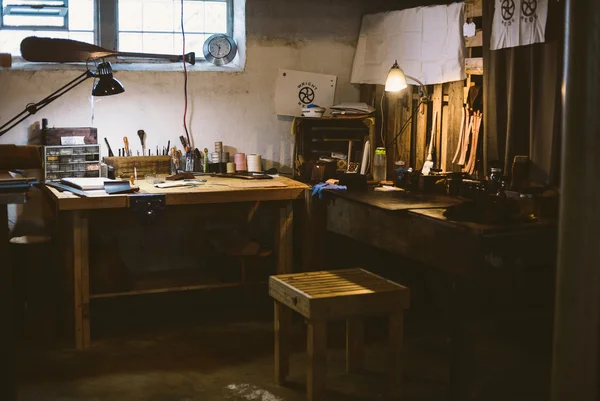
I had to come face to face with this a few weeks ago. I'm planning on relaunching this website sometime soon and as part of that I had a photographer come over and take some pictures in my "workshop" (read this with fully intentional air quotes around it).  At first I really didn't want to shoot here because the reality is that it is located in my sad, crappy basement. There is no golden hued light streaming in through barn windows. I've got glass block and fluorescent bulbs. There is laundry I haven't gotten to yet in the corner. My tools are not family heirlooms oozing patina. They are the cheapest ones I could find that would get the job done. For some reason I felt like I had to hide all of this. Like I wasn't legit unless I had a shop-dog napping next to a freshly baked blueberry pie cooling on the window sill complete with antique silver server.

Then I realized that is a bunch of crap. I started this business a little over a year and a half ago with $150. I turned that into a business that I can do full time. I have waded into the deep water and painstakingly hauled my life back on to shore. I've done it all in my crappy basement with my ugly tools.

You don't need perfect lighting, artsy tattooed friends, a rehabbed industrial studio space, a white washed house in the country, or a set of tools that look like they were last used by Noah while building the ark.

People do amazing things every day with what is available to them. Most of them don't even live in the Pacific Northwest. All you need is the desire for change, the will to take action, and the determination to keep moving forward. It may not always be pretty, but it is pretty damn notable.


Mind Your Own Business

Anxiety and insecurity are constant companions when it comes to running your own business. Taking the path less traveled means you'll be walking hand-in-hand with the fear of the unknown. Worrying about what everyone else is up to is a pretty normal part of the process. You worry about how your competitors are doing. You worry about your peers being more successful than you. You worry about how the market will respond to you.

What I have come to accept is the fact that absolutely none of these factors are under my control. It is easy (and dangerous) to fall into the trap of following your competitors too closely. You see a nice write-up they got and you start to feel like you're doing something wrong. They get a grant or come out with a great new product and it feels like you lost at something. You start trying to figure out what you can do to respond to these developments, which seems like a productive idea, but really it's a trap. If you spend all of your time responding to what everyone else is doing you are guaranteeing yourself a position that is always playing catch up.

When I find myself slipping into this mindset I remind myself, mind your own business. Work on developing your skills. Create better products. Refine your designs. Push yourself further down your own path because that is something they will never be able to beat you at.

When you start to focus on your own business you come up with your own novel solutions, seize the opportunities that are right for you, and force everyone else to respond to what you are doing. Except, you won't care about that because you will have already moved on to something else.

Some new additions to the shop.

I've gotten a little design time in last month. So there are some new additions to the shop.  

First I've finally started to play around with some leathers other than the vegetable tanned leather I usually work with.

Oil Tanned Magellan

This is the Magellan Notebook reworked with some Oil Tanned Leather.

Oiled Small Case

And I came up with a little pouch made from the same. If you are not familiar with oil tanned leather it was mainly used for chaps and motorcycle bags since it's pretty water resistant. It also has a pull-up which means the leather gets lighter where you bend and scratch it. It's also a lot softer than veg tan leather.

Finally I released a new version of the passport case. This is the first time I'm making them available online. This is version 3.0 for those playing along at home.


2014-05-20 14.09.58-1


All of these new items and many others can be found in the store here.


Screw Up With Style

My story has always be about taking an honest look at starting a business. So here is a little honesty. Okay, so I screwed up. As I get busier, and I make more and more things, I'm bound to make some mistakes every once and a while. Last week I screwed up. I'm going to tell you all about it because there is a really good lesson in it.

I decided to test out a new thread from a different supplier. I was making watch straps that day and decided to make myself one to see how it would break in. The following day I had a show and without realizing it I packed up the strap I had made for myself. While I was setting up for the show I grabbed this particular strap out of the straps I brought, put it on a watch, set it on the table, and thought nothing of it (because I thought my tester strap was still at home).

I have a nice show and I'm feeling pretty pleased with myself. Then Monday rolls around and I can't find the strap I made for myself. Then I get an email. It basically says, "Hey I bought this watch off you yesterday (Editor's note YESTERDAY!!!). It looks really nice but it's kind of falling apart..."

And my heart sinks. I immediately start thinking worst case scenarios.  I mean the main point of everything I make is that they are very durable. This guy has had the thing for less the 24 hours. He must think I'm either trying to screw him over or I'm a total asshat.

Here is where a lesson I learned in my previous life comes into play. I wish I could remember who said this to me, but it was probably said in a moment of chaos. Every screw up is a chance to prove how good we are.  As a server in a restaurant you get to apologize a lot. Even when something happens in the kitchen and I had nothing to do with it, it is still my job to go apologize to the table.  So having to learn how to fix mistakes is an art that any good server has to master.

So I stopped freaking out and starting thinking about this as a challenge. The first thing you should always do is try to meet the customers expectations. In this case they wanted a nice looking strap that doesn't fall apart. First I apologized and took responsibility.  I asked him to give me a chance to fix it. Either mail it back to me or drop it off at a show (one of the benefits of having a busy show schedule if you don't have a storefront) and I'd fix it and get it right back to him. He decided to mail it because he wanted it back ASAP.

I received the strap in the mail two days later. The mail arrived at 10 am. Within the hour I had the strap restitched. I then gave it a nice cleaning with saddle soap and re waxed the entire thing. I let it dry and spent a good amount of time messing with the stitches to make sure they wouldn't come loose. I then sat down and made another strap. Why? If for some reason this one got lost or ruined in the mail I'd have a backup ready.

I then sat down and wrote out a nice email letting him know that I had received the strap, it was already fixed, and explained what I'd done wrong.  Once it was dry I packed it up, added a matching keyring to the package (because I was grateful for the chance to try again) and had it in the mail the following morning.

This morning I got an email from the customer. The strap and keyring had arrived successfully. Not only that, but he was looking forward to using them " proudly."

I think that is really the lesson here. Just like how you can see what a person is really like when they are down, you can see the same with a business. It's important to impress people when you are doing to good job. It is even more important to shine when you have really screwed up. Because that is what I am really selling.

You can buy a watchstrap online that was made in a factory halfway across the planet for a lot less. I'm not reinventing the wheel here either. When someone buys something from me they know that I've put my heart into it. They know that I actually give a crap about what I'm making.  They get the confidence that what I've made is up to my highest standards and if it comes up short then I really want to make it right. They know that I am proud of the work I am doing. I have invested myself in it, and they should be able to be proud knowing that they made a good choice in buying it.

As a business owner you are going to screw up. It is inevitable. What is important is that when you do; you screw up really well.


(As a side note, if the watchstrap belonged to you and you are reading this: thank you very much for your email. A happy email resulting from something I screwed up is invaluable.)

The Wholesale Question

One continually evolving issue that I have to think about is whether or not to offer my items to wholesalers. It's a question that many makers will have to think about at some point and I've spent a fair amount of time making decisions (and then changing them) since starting Wright and Rede. I thought it might be helpful to write down some of my thoughts on the issue.

If you want your stuff to be carried in a brick and mortar store  (or online for that matter) that's not yours, you generally have two options; consignment or wholesale. Each has it's pros and cons and there is a correct and different way I handle each type of account.


I see a wholesale account as a owner-to-customer relationship. The wholesaler will order a larger quantity of your goods in exchange for a discount so that they can resell them at a profit. This can be a single transaction or a repeatable transaction. I say it is a customer relationship because people seem to forget that just because you landed a wholesale account does not mean that they'll ever order from you again. Like any customer, they expect quality customer service with their purchase. They are going to expect well made goods that are thoughtfully packaged, cross promotion of their store, and ready trouble-shooting if any problems arise.

The Pros:

The right wholesaler can add to your brand identity. Getting your things carried in a really cool store can make you cooler by association.

A good wholesale account can introduce you to new markets.  If you live in Cleveland trying to sell your goods in L.A. can be kind of difficult.  A good wholesale account (who is enthusiastic about your goods) can excite and educate potential customers in that area.

They can sell when and where you can't. If a customer wants to check out your goods, but you don't have a storefront, you can direct them to the wholesaler to see your goods in person. I found this to be very helpful during the holidays. Towards the end of a show I might run out of something. It's handy to be able to tell someone that you're all out of phone cases but they can check out so-and-so's store because they still have some in stock. This can be especially handy a few days before Christmas when people are a little panicky and you are running low on product.

A wholesaler has an investment in your product. They've already spent money on your goods which they need to see pay off. They have a fairly large incentive to make sure that your goods are being presented in the best possible way to sell. 

The Cons:

A discount of 50% is pretty standard for a wholesale account. Can you make a living selling your goods at 50% off? Is it worth it? Are you charging a price that will allow you to sell at that much of a discount?

Your pricing structure gets linked to your wholesale accounts. Let's say you try out a new product. You charge $50 for it. A wholesaler loves it and buys 20 of them. Turns out that new design wasn't the hot item you thought it would be and you want to keep producing it, but at a lower price point. How happy is your wholesale account going to be when they see on your website that you are selling the item that they have to charge $50 for at only $35?

How many will they be ordering? Let's say a really cool store wants to carry a new item that you are making. The new design is a pain-in-the-ass to make but you really want to be in this store. So you cut them a good deal. You bust your butt getting the order out and you don't make much money in return, but hey you can tell people that you are in that really cool store. Then they never order from you again.

The opposite side of that coin is even worse. They order a ton from you on a regular basis. You're so busy filling their orders that you can't make your own stuff. Now you are in the business of providing one pain-in-the-ass-item at less than you should be charging for it. Iif any of your own customers wants one you can direct them to this really cool store where you will be making less than 50% of what it is worth.

You'll need to invest a fair amount of time writing out a wholesale agreement (that clearly defines the relationship) and coming up with a price sheet (with pictures and descriptions).


Consignment is a different kind of relationship. I think of a consignment account as taking on a small business partner. The arrangement is basically that you will be the back-end (manufacturing) and they will be the front-end (distribution and sales) and then you'll split the sales 50-50. (Notice I said sale and not profit.)

The Pros:

Consignment agreements tend to be a little looser. Most stores will ask to carry your stuff and you can decide what specifically to bring them. This can be a great way to promote a new item. You can also tailor what you bring to the account. You can work with the consignor to figure out what will move the best at their location.

Many consignment agreements will allow you to adjust your prices and inventory as situations change. If you thought something would go over well, and instead they're just sitting on the shelves, you can frequently ask the shop owner if you can swing by and switch some stuff out.

Like a wholesale store, your items can be found in times and locations where you aren't present. If you have a bunch of accounts and decide to take the day off, your consignment accounts are still out there trying to sell your goods for you.

Consignment stores are always bringing in new vendors. As a result they tend to have very active social media campaigns. A supportive consignor can give your social media platforms a nice little boost.

Because the inventory is fairly flexible in a consignment shop, new products getting dropped off by the other vendors will help add to the interest for that location. If the shop owner is doing a good job curating the store then this means a steady supply of interested customers even though you aren't coming up with a new product every week.

The Cons:

The relationship with a consignment shop is very different from a wholesale account because they are looking for a different return on investment. A wholesale account is looking to get their money back. So it is in their best interest to move items that are selling poorly.  A consignment shop is looking to make the most profit on the space and energy they have allotted to you. If your items aren't selling, then they probably aren't going to get a prime spot in the store and not much enthusiasm from the staff. A bad consignment deal can turn into a graveyard for your goods.

You are going to get product back at some point. If you have a consignment deal that isn't working out, and you pull out of the shop, you are going to get back all of the product that they were holding for you. This can be a boon if you are low on stock. More likely you will be getting back a bunch of stuff that didn't sell. There is also a good chance that the stuff you get back has been sitting around for a little while and may no longer be up to your more developed standards as you improve your skill level.

You'll be signing a contract. Most run from 6 months to a year. If the consignment deal turns out to be a dud you're going to be dealing with them for the length of the contract.

Consignment shops tend to profit off of quantity of dealers not necessarily quality. This is not always the case. I can think of several consignment shops that carry really fantastic stuff. In general the shop is betting that enough of their dealers will be profitable to make their business successful. The more dealers the better chance they have of finding a winner. Sometimes this means that you get to have your stuff surrounded by a great mix of popular items. Lots of times it means that the shop needs to try out new dealers on a regular basis and some of these dealers don't have the same standards for their business as you do for yours.

Signing with a consignment shop really is like taking on a business partner. They will be getting 50% of the total value of everything you give them. Ideally you should be reviving 50% of that value in service back from your consignor.  This means promotion of your goods in the store and on social media, proper merchandizing (making your stuff look appealing in the store), educated and interested staff, theft-prevention and security, and reliability. If you sign a contract with a store that turns out to have pissed off lazy staff, they close the store randomly and at odd hours, the only people who know your stuff is there are the people who you send in there, and they display your stuff in a dusty stack in the corner, you are going to be dealing with them for the next 6-12 months.

In general I wouldn't recommend consigning with a store that I can't get to on an occasional basis. When I ship out a bunch of product to a new store I now have a significant investment in that store. The responsible thing to do is to occasionally make sure that your investment is well placed. You should stop in every now and then and make sure that your product is being looked after. Most consignment shop owners are friendly and want to see a client that is engaged in their store. If you live in Cleveland and the store is in Atlanta you are pretty much hoping that they are holding up their end of the deal.

Another issue from having distant consignment accounts is inventory related. Let's say I sell t-shirts and I get a check saying that I sold 12 shirts that month. Fantastic, were those Small, Medium, or Large? This is a pretty common issue. If you can't get to the store and figure out what sizes you need to restock and the store's owners or employees aren't cooperating, trying to restock that store is going to be a regular pain in the butt.

There is also the possibility that they sold 20 of my shirts and paid me for 12 of them. I'd have no way of knowing this if I couldn't stick my head in there every now and then. I've never had this happen to me. I know of many people who have had this happen to them. It sucks and it happens.


My Guidelines

So was that a lot of information to take in? Most of these issues will be relevant to your business in specific ways. If you are a graphic designer selling posters, and getting a bunch printed off isn't a huge deal, then consignment shops all over the country might be a great option for you. If you are a ceramicist and making really labor intensive products, consignment and wholesaling may be the wrong answer for you entirely.

For myself I stick by these rules (which will probably get changed as my business grows and changes).

  • My goods are labor intensive so I limit the total number of accounts, of any sort, pretty heavily.
  • Not every item I make is offered to my accounts.  Some things I just can't make at 50% off.
  • I have almost zero consignment. I love the idea, but I have discovered that the proportion of investment between the two parties is rarely equitable.  The only consignment I do these days usually involves some sort of pop up shop, seasonal event, or a very specific goal or cause.
  • I will not take on a consignment account that I can't comfortably drive to and from in a day.
  • I try to walk though any store I'm going to have my goods sold in. If possible I do this anonymously. While there I will look at the other goods sold, their price point (I don't want to have the most expensive or cheapest goods in the store), and how they are displayed. I try to ask some casual questions of the staff to see how engaged they are. Finally I look to see if the store is getting managed properly. A little chaos is fine. My workshop is a mess sometimes, so I don't judge. There shouldn't be boxes piled up around the store, broken display pieces, or frazzled or clueless staff.
  • Is the shop brand appropriate? This has been one of the hardest ones to deal with when starting up. At first it's really exciting to have someone want to carry your stuff. Especially if it's a wholesale account and they want to give you some money. I ask myself if I'd be happy telling people my stuff is there. A shop that sells local handmade things, a shop for guys, a shop for rugged outdoorsy things, a cool stationary store, might all be good matches. A shop that sells accessories for girls ages 4-12 and is called Silly Sally's Princess Palace (I just made that up, but if you're out there SSPP I love your store name)  is probably not the best image for my brand.
  • I sell things personally all over Cleveland at all times of the year. I also sell on this website 24/7. Since what I produce is labor intensive, and I can only make so much, having a bunch of accounts (wholesale or consignment) all over Cleveland isn't the best option. If I'm selling everything I make then supplying a bunch of shops in my same area, instead of producing for myself, doesn't make much sense.
  • The number of shops I'm willing to take on is also influenced by the amount of variation I can generate between my products. It's doesn't make any sense to have four stores selling the same thing in a 1 mile radius.

Like I said these are just some of the guidelines I've developed for making decisions on what accounts to accept or pursue.  As my business grows and changes so will these guidelines. I think the most import thing is to have a set of rules that help me figure out which opportunities are good ones. It also helps me feel more secure when I have to tell someone no.

If you are a maker or store owner I'd love to hear your input as I'm always evolving my opinion on this. You can comment below or email me at jordan@wrightandrede.com if you are worried about airing your dirty laundry on the internet.


Be Perfect Later

I started off this morning watching this really intelligent presentation by Kathryn Minshew for 99U called "7 Classic Startup Founder Mistakes and How to Avoid Them".  The one mistake that really stood out for me was the one she calls "Perfect vs. Done". This is a trap I fall into all of the time, and since I'm writing this at the cusp of busy season, I think it is very relevant.

For me there is a constant tension between designing a product to completion and making a product to sell. I know a lot of people who have this same issue. I can't tell you how many people I've met that have failed to execute a really great idea because they never felt it was ready.

The thing I am starting to realize is that what I'm trying to make will never be ready. It will never be perfect. Worse, if I spend all of my time trying to make something that is perfect I'd never make anything at all. Even if I managed to put something out there that I thought was ready, in a year you could show it to me and I'd tell you all the things wrong with it.

This can be a trying struggle because I can't (no one can) make something that matches the ideal in my mind, but I'm also responsible for making something to sell.

I have come to realize that this is an issue of perspective. From my perspective I want to execute a flawless design. Like any good craftsman, I always want to produce my best work and any shortcomings in my execution are viewed as failures. From my customer's perspective, they want to buy a good that will provide value in their life.  Where I see a product that never quite lives up to the idea in my head, my customers see something that looks good and holds their business cards.

Will I produce something better next year? Will that card holder be more "ready" next year? I really hope so. Is it wrong of me to sell that card holder today even though I know it will be better tomorrow? Not if I'm producing it to the best of my ability. If I am doing my job right the person that buys my card holder today will enjoy having it enough to want to seek me out in the future. If I'm really doing my job right they'll be even happier with what I make down the road.

The trick seems to be to always reach for the ideal in your head for tomorrow, but produce something you can live with today.

The Weathered Leather Experiment Month 5.

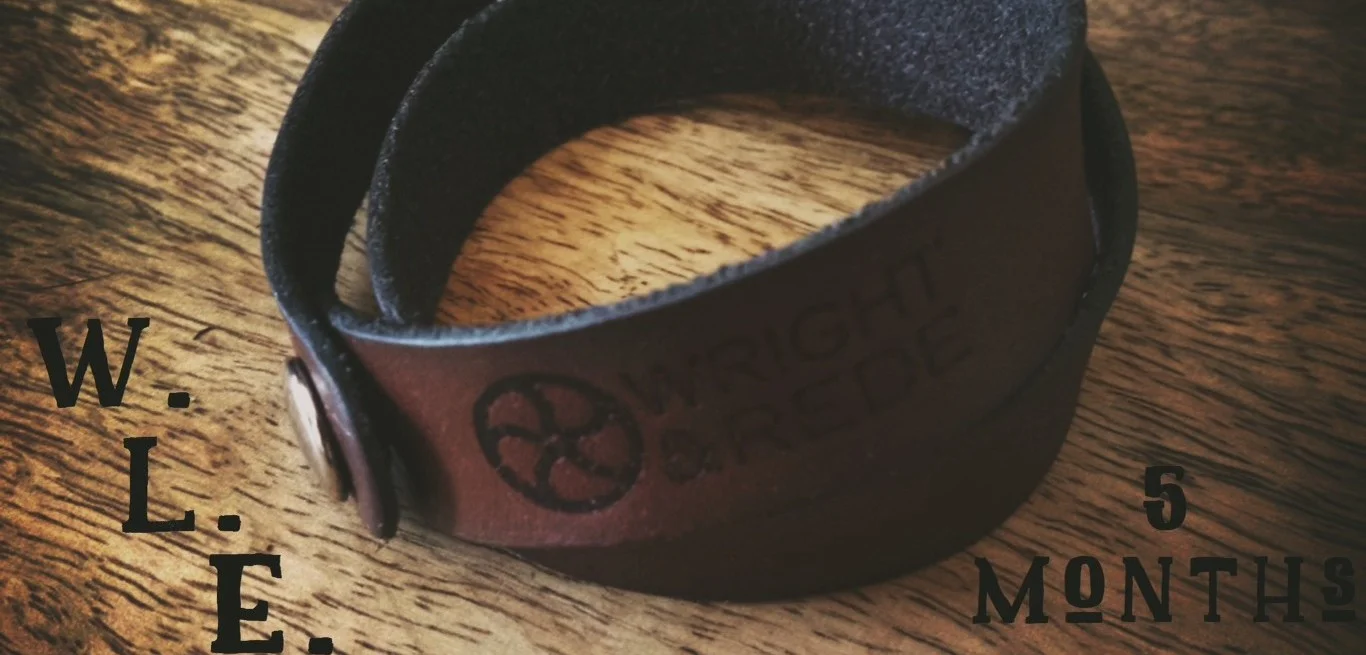
I wasn't expecting too much to change last month. With the subzero arctic temperatures most of the bracelets are not getting much sunlight. It's like S.A.D.D. but with bracelets.  There is still quite a bit of variation considering that they all looked the same five months ago. 


#1

1


#2

2


#3

3


#4

4


#5

No Image.


#6

No Image.


#7

8


#8

7


#9

9


#10

10


#11

11


#12

No Image.


#13

No Image.


Finding Your Artistic Vision

I was never a very good art student. I would not have made a very good Artist. The problem is that I've always been too practical.  I can't justify asking someone to spend money on my work when there is no practical benefit. You can't eat it.  It doesn't provide shelter.  It won't make you healthy. 

Some people might disagree with that last statement. They would say that art can provide meaning, clarity, or solace in an otherwise cold and confusing world. I agree with that. Art can be a very powerful thing. Just not the art that I was making.

My problem was always transitioning from craft to art. Craft is the study and use of the process. Art is the reason why. During class critiques I'd would hear things like, "This portrait represents mankind's struggle against alienation in a world where technology is ever present" or, "This is a still life of items left behind by my grandmother. She raised three children in a Japanese internment camp". I was just making things that I thought looked good.

I think that is why I've fallen so happily into the life of being a craftsman. You may not be able to seek shelter under something I've made, but at least you've got a place to keep your library card. The tricky part is that successful craftspeople don't just make things really well. They have a vision of why they are making what they make. 

Since starting my business and fully devoting myself to my craft I've discovered something really interesting. You don't start out with a vision. You end up with one. I'll be the first person to admit I didn't start out with a vision. I started because I was sick of waiting tables and working nights. It has been only recently that I have really been able to say what kind of work I make and why I make it. This is not a process that you can rush no matter how much energy you devote to it. It's kind of like growing up.  Below is my take on it.

The Steps of Creative Development:

Step One: The Baby Phase. When I started leather working (or anything really) everything was new and exciting. I knew very little about what I was looking at and it all seemed amazing. During this stage I collected everything into my mental database and stored it all away. There is no curating or direction. It's all great. Like shiny car keys.

 Step Two: The "I want to be just like older brother" or the Aping Phase. This is when I started to have a little bit of discernment. I had found a few people who's work I really liked. Makr, Will Leather Goods, and Bexar Goods Co. were chief among them.  I spent a lot of time making really bad knock-offs. This is a normal and healthy thing. Most classically trained artists and craftspeople spend their early days producing stuff that looks like other people's work. The important part is that I saw this for what it was and knew that I had to make work that is my own. Don't sell your knock-offs!

Step Three: The Terrible Twos (or the Everything I Make Is Crap) Stage. Turns out you can't look at a Picasso and then sit down and paint like Picasso. No matter how much time I spent staring at the Makr website I couldn't make anything that looked as good. Stage Three is filled with a lot of nos. I started to learn what works for me with my methods of production. A style that works really well for Will Leather looks really bad when it comes from my hands. So I started to cut back on what I was trying to make and started making what I could make.

Step Four: The Snotty Teenager. I knew what I could do and I was starting to make work that looked like my own. Here is where I almost got caught up. I found a narrow space that I could occupy and thought, "okay, this is the kind of work I do."  This was a comfortable place because for the first time I could tell what I didn't want to make. Designing got a little easier and I spent a lot of time dismissing other peoples work. "Ugh,  I don't like polyester thread", "look at how sloppy that stitching is", "that design really sucks."

 Step Five: Moving Out of Mom's House. This is the stage I spent most of my time in (I still do spend a lot of time at this stage). Here is where I stopped worrying about what everyone else is doing. I don't see how I could have gotten to this stage without quitting my day job. When I had to start making a living, I stopped focusing on the outside world and really began to focus on the work I was producing. Instead of trying to find a new clever wallet design I was more focused on making sure I had enough product on hand for the show I was doing that weekend.

This sounds like the most boring phase, but I found that by keeping my nose to the wheel I began to really develop my vision.  When I would dye ten or twenty wallets in a row I found that there were some I liked more than others. I began trying to replicate those features on the next round of wallets. It's not always a conscious action either. There are a lot of little tricks that my hands have picked up on that my brain is not aware of. As a result I'm a lot faster now than when I started.

I also learned that I like the funkier leather. Vegetable tanned leather will show off all the scratches and weird blotches when I dye it. I started trying to bring that out more in my process. I like things that are simple and clean. My design work reflects that. I like things that look old, so I try to make things that will age beautifully.

I wouldn't have learned any of this with out grinding out the work that I have to do on a daily basis. It's a type knowledge that is gained in increments.

  Stage Six: The World Traveler. This is the stage I'm just starting to get into. I don't think anyone really gets to spend all of their time here. It seems like most people jump back and forth between 5 & 6. I couldn't have gotten to this stage without the confidence that was built up in the previous step. This is the stage where I'm confident enough in my vision to draw intelligent inspiration from around me and use it to create work that speaks with my own voice.

I'm not all the way there yet. I'm not sure that this is something I can reach the end of anyway.  I have learned that they only way to get here is through consistent and thoughtful work. I first had to learn what I didn't want to make, how to make what I did, how to stop worrying about what everyone else is doing, and then finally I could start to understand what I had to say.


Developing Artistic Vision

I was never a very good art student. I would not have made a very good "A"rtist. The problem was that I was always far too practical.  I couldn't justify asking someone to spend money on my work when there was no practical benefit. You couldn't eat it.  It didn't provide shelter.  It wouldn't make you healthy. 

Some people might disagree with that last statement. They would say that art can provide meaning, clarity, or solace in an otherwise cold and confusing world. I agree with that. Art can be a very powerful thing. Just not the art that I was making.

My problem was always transitioning from craft to art. Craft is the study and use of the process. Art is the reason why. During class critiques I'd would hear things like, "This portrait represents mankind's struggle against alienation in a world where technology is ever present" or, "This is a still life of items left behind by my grandmother. She raised three children in a Japanese internment camp". I was just making things that I thought looked good.

I think that is why I've fallen so happily into the life of being a craftsman. You may not be able to seek shelter under something I've made, but at least you've got a place to keep your library card. The tricky part is that successful craftspeople don't just make things really well. They have a vision of why they are making what they make. 

Since starting my business and fully devoting myself to my craft I've discovered something really interesting. You don't start out with a vision. You end up with one. I'll be the first person to admit I didn't start out with a vision. I started because I was sick of waiting tables and working nights. It has been only recently that I have really been able to say what kind of work I make and why I make it. This is not a process that you can rush no matter how much energy you devote to it. It's kind of like growing up.  Below is my take on it.

The Steps of Creative Development:

Step One: The Baby Phase. When I started leather working (or anything really) everything was new and exciting. I knew very little about what I was looking at and it all seemed amazing. During this stage I kind of collected everything into my mental database and stored it all away. There is no curating or direction. It's all great. Like shiny car keys.

 Step Two: The "I want to be just like older brother" or the Aping Phase. This is when I started to have a little bit of discernment. I had found a few people who's work I really liked. Makr, Will Leather Goods, and Bexar Goods Co. were chief among them.  I spent a lot of time making really bad knock-offs. This is a normal and healthy thing. Most classically trained artists and craftspeople spend their early days producing stuff that looks like other people's work. The important part is that I saw this for what it was and knew that I had to make work that is my own. Don't sell your knock-offs!

Step Three: The Terrible Twos (or the Everything I Make Is Crap) Stage. Turns out you can't look at a Picasso and then sit down and paint like Picasso. No matter how much time I spent staring at the Makr website I couldn't make anything that looked as good. Stage Three is filled with a lot of nos. I started to learn what works for me with my methods of production. A style that works really well for Will Leather looks really bad when it comes from my hands. So I started to cut back on what I was trying to make and started making what I could make.

Step Four: The Snotty Teenager. So now I knew what I could do and I was starting to make work that looked like my own. Here is where I almost got caught up. I found a narrow space that I could occupy and thought,"okay, this is the kind of work I do."  This can be a really good place because for the first time I could tell what I didn't want to make. Designing got a little easier and I spent a lot of time dismissing other peoples work. "Ugh,  I don't like polyester thread", "look at how sloppy that stitching is", "that design really sucks." Now I'm not saying I'm above a little Schadenfreude from time to time, but at this point I didn't really have a right to talk. I was no longer producing work that sucked but I wasn't exactly Corter Leather either.

 Step Five: Moving Out of Mom's House. This is the stage I spent most of my time in (I still do spend a lot of time at this stage). Here is where I stopped worrying about what everyone else is doing. I don't see how I could have gotten to this stage without quitting my day job. When I had to start making a living, I stopped focusing on the outside world and really began to focus on the work I was producing. Instead of trying to find a new clever wallet design I was more focused on making sure I had enough product on hand for the show I was doing that weekend.

This sounds like the most boring phase, but I found that by keeping my nose to the wheel I began to really develop my vision.  When I would dye ten or twenty wallets in a row I found that there were some I liked more than others. I began trying to replicate those features on the next round of wallets. It's not always a conscious action either. There are a lot of little tricks that my hands have picked up on that my brain is not aware of. As a result I'm a lot faster now than when I started.

I also learned that I like the funkier leather. Vegetable tanned leather will show off all the scratches and weird blotches when I dye it. I started trying to bring that out more in my process. I like things that are unfussy and my design reflects that. I like things that look old, so I try to make things that will age beautifully.

I wouldn't have learned any of this with out grinding out the work that I have to do on a daily basis. It's a type knowledge that is gained in increments.

  Stage Six: The World Traveler. This is the stage I'm just starting to get into. I don't think anyone really gets to spend all of their time here. It seems like most people jump back and forth between 5 & 6. I couldn't have gotten to this stage without the confidence that was built up in the previous step. This is the stage where I'm confident enough in my vision to draw intelligent inspiration from around me and use it to create work that speaks with my own voice.

For example, here is an iPad case  I did over the holidays. The blue part was inspired by a Japanese textile pattern that represents waves. I include a journal with all of my cases in that hope that this will be something that you carry with you on the journey of your life. The waves speak of the journey. The contrasting color scheme inspiration came from a really old Louis Vuitton logo that was screened onto some of their bags. You can see how nonuniform the grain is which has been brought out by the dyeing process. I tried to create a contrast between the highlights and the darker areas of the leather. This reminds me of old photographs.

Why I'm doing what I'm doing not always a straight forward answer, but the spirit of my personal style is beginning to show. I'm very focused on gradient and tone on the leather's surface. I'm always referencing my love of personal history and my hope that someday my work will become part of it. I like things to be simple and unfussy. 

I'm not all the way there yet. I'm not really sure that this is something I can reach the end of anyway.  I have learned that they only way to get here is through consistent and thoughtful work. I first had to learn what I didn't want to make, how to make what I did, how to stop worrying about what everyone else is doing, and then finally I could start to understand what I had to say.

If you would like to see where some of my inspiration comes from I've set up a Tumblr account where I keep a curated collection of things I find that visually inspire me. I also have a Pinterest account where I like to keep inspiration for projects I'm actively working on. If you are active on either platform please look me up as I'd like to see what inspires you.


The Hard Way


"Well, you've got two choices. We can do this the easy way, or we can do this the hard way."

--Dr. Saunders, pediatrician, before giving me every shot I ever had as a child.


I don't remember Dr. Saunders very well. For some reason he looks kind of like Orville Redenbacher in my recollections of him. He also had a big, brusk nurse who must have modeled for Nurse Ratched at some point. He was an old man when he said these words to me. He was a young man when he said them to my mother for the first time. He was her pediatrician too. 

What I do remember about him was this saying. I think about it often.  I always chose the hard way, which involved a bear hug from Big Nurse, tears, and a lot of evasive squirming. I haven't really changed much as I've grown up. While I can now take a booster shot like a champ I still find myself choosing to do things the hard way.

I try not to judge. Some people are good at the easy way. I'd probably produce a lot more. I'd probably be less busy, work at a different job, and stress out a lot less. I don't think I would be very satisfied.

Somewhere in me there is a deep conviction that for every solution there is one right answer. I can't figure out what that right answer is until I've seen all the wrong answers. When I'm designing something new I have to spend an unconscionable amount of time creating God awful, over-designed messes before I get so tired of thinking about it that I just cut out all of the unnecessary crap.  Suddenly I'm left with the right answer, the bare bones of the idea, and I'm always surprised and annoyed by how simple of a solution it ended up being. 

This is why I hand stitch everything. It's stronger. It looks better. It's the right way. This is also why I hand dye everything instead of buying already dyed sides of leather. Because if I dye it myself I can control the color and make it look the way I think it should look. Make it look right. This is why I've spent months and months trying to formulate my own dye rather than sticking to the store bought stuff when store bought works just fine.  By making my own I can control it better. I can be sure that I'm not spreading harmful chemistry onto something that people touch everyday. I can make it from locally sourced ingredients. I can make it naturally. I can do it the right way.

I've never figured out if the hard way is the right way, or if I'm just taking the hard way to get to the right answer.  I know that when I find the right answer it comes with a feeling of conviction. I know that in all the time I've spent learning from the wrong ways I've built a foundation for something that may not be perfect (nothing ever is) but is on the right path.  I feel like it takes all the little right pieces from all the wrong answers to build something that is right.

So I might always be the Tortoise and not the Hare. I might miss out on some perceived opportunities because I'm being stubborn. I probably spend more hours being frustrated and less hours sleeping than I should. In the end I'll always choose the hard way with the right answer. That is good enough for me.


The Weathered Leather Experiment Month 4. The Naughty or Nice Edition.

I've been told that almost all of the bracelets have recovered from the holiday season and are already starting to think about getting a nice tan in that warm summer breeze....


#1

 1       

#2

2

#3

3

#4

4

#5


????


#6


????


#7

7

#7 Has been adopted and is now in a new home. This one is out delivering mail everyday so I'm interested to see how it ages in it's new place.

#8

8

Sounds like #8 had quite the festive season. Not only did it attend numerous social gatherings, but #8 also "bounced from wrist to wrist at a few parties."  Hey, what happens at the Christmas party stays at the Christmas party...

#9

9

#10

10

"The bracelet seems to like shoveling snow." :)

#11

11

#12

12

#12 has reemerged and got a new coat of dubbin in between Polar Vortexes.

#13

13

#13 is just having some beans and reading the funnies.

Leather Care Tutorial

Leather Care Tutorial

 The best thing about high quality, vegetable tanned leather is the way it ages. Instead of wearing out, a well treated piece of leather will age like a good Scotch. If you want your new leather item to look better in five years than it does today, you are going to have to take care of it. Below I have detailed the the complete process of restoring an old leather document case. Most of the time you will only need to oil or condition your leather (steps 4-7). If it has been a while you probably want to start with Step 1.

**All conditioners will change the way that leather looks to one degree or another. Always test on a small hidden spot first to make sure you are okay with the change.

This document case used to hold life insurance certificates. It is a little over fifty years old. Judging by the feel of the leather it hasn't been treated in a long time. How can you tell if your leather needs to be treated? Leather is tanned flesh and just like your flesh it will feel stiff and dry when it needs a little attention. When your leather looks dull and is not as supple, it is time to condition.

Step 1: Start with a clean, flat surface. This is actually important. The leather will be more susceptible to scratching and creasing when it is getting conditioned. If there is something sitting underneath your leather while you are buffing there will be scratches when you flip it over.

Step 2: Start by cleaning the leather with a good saddle soap. I always start by cleaning the leather. There is a good chance you've gotten some kind of junk (hand lotion, fry grease, motor oil) on the leather which will cause the oil in the next step to absorb unevenly. Blotchy only looks good on Rorschach tests.  Here I am using Fiebing's Natural Saddle Soap. Make sure you are using saddle soap and not "leather cleaner". Most cleaners have alcohol or solvents in them that will dry out the leather. Pour a little water into the lid of the container, lightly moisten a rag (old t shirts are great for this) and work up a good lather on the soap. Take the soapy rag and start gently working the lather into the leather in a circular motion.

Don't forget the edges. The oils in the soap will start to absorb into the leather. It will start to darken and get softer. As the soap dries the oils will sink deeper into the leather and help pull in the oil in the next steps.

Step 3: Let it dry completely. This can take as little as a few hours, if the air is very dry, up to over night. Usually, I would recommend over night. If there is any water left on the surface of the leather it will prevent the oil in the next step from soaking in properly. Again, Rorschach. 

Step 4: Pour a small amount of oil on to a clean soft rag. What kind of oil? Neatsfoot and mink oil are the traditional answers. Olive oil will also work, but this does tend to darken the leather quite a bit. Variations in different types of olive oil can also cause unexpected results. Work the oil around on the rag to distribute it evenly. If you put a big blob of oil right onto the leather your going to get a big dark splotch.

With a swift and light circular motion, begin to apply the oil. You don't need to grind it into the leather. Remember that the top grain on the leather will be delicate at this point. Try to not let the rag rest anywhere for too long or you'll get a darker patch there. You can tell how much oil the leather needs by how quickly it absorbs the oil. Keep adding light coats of oil until it absorbs at a less dramatic rate. 2-3 coats should be enough.

Here you can really see how much the leather darkens. As the oil works it's way deeper and the surface begins to dry it will lighten up a bit. Well conditioned leather is always a little darker after being treated though.

Step 5: Once you have a nice even coat of oil on take a moment and really work it in using your fingers. The heat from your hands will help the oil penetrate deeper and you won't have to condition as often.

Step 6: After letting the oiled leather sit for 24 hours it is time to apply a little waxed based protection. Oil will soften the leather and keep it supple. It will also dry to a sad looking matte finish. Wax will bring back that just oiled glow and will also provide a little water resistance. Here I am using Obenauf's Heavy Duty LP. Huberd's works well too.  A good leather protectant will smell like bees wax (from bee propolis, a resin bees produce to make the hive waterproof) or a campfire (from pine resin which pine trees produce to make pine trees waterproof...). Do not use anything labeled as a leather sealer. Most of these are acrylic based and will eventually fail and peel off or crack; taking the top layer of leather with them.  If it smells like chemistry find something else.

Apply a light coat of wax to the surface of the leather. If you apply too much you'll only have to spend more time buffing it all off at the end. You aren't really worried about feeding the leather at this point. Just get a nice thin layer on and work it into all the creases and ridges with your fingers.

Make sure you get the areas along the the stitching and any creases or folds really well. This is where the leather is most vulnerable and you want a little extra protection there.

Step 7: Let the wax dry over night. In the morning the surface will feel a little tacky and have lost it's luster again. This is the fun part. Take a large clean rag (I like old bandannas for this) and start buffing. Light and fast is best. You can tell if you are doing it right because the color of the leather will deepen and it will start to shine. The more you buff the more it will glow so spend some time doing this properly.

Here you can start to see the difference. The bottom section has been buffed. It has a richer color, a satiny luster, and is no longer tacky. If you went a little nuts with the wax you might be buffing for a little while. Just keep going until there are no dull spots and the surface looses its tackiness. 

I like to let the wax cure again over night at this point. This step might be unnecessary but why accidentally screw up your hard work after all that.   You're all set for the next 6-12 months.

Have trouble remembering when to recondition?  I'll remind you! Sign up for the Leather Maintenance Mailer and I will send you a reminder once every six months.