Making a Mercer Briefcase Part 2.
Hand dyeing and burnishing vegetable tanned leather.

Making a Mercer. Part 2.

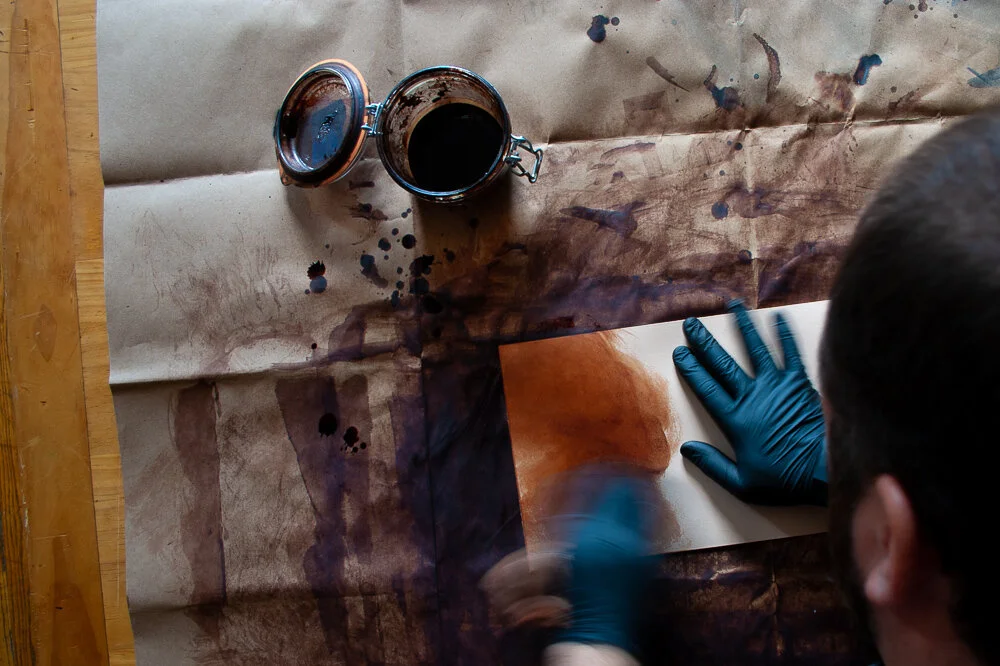
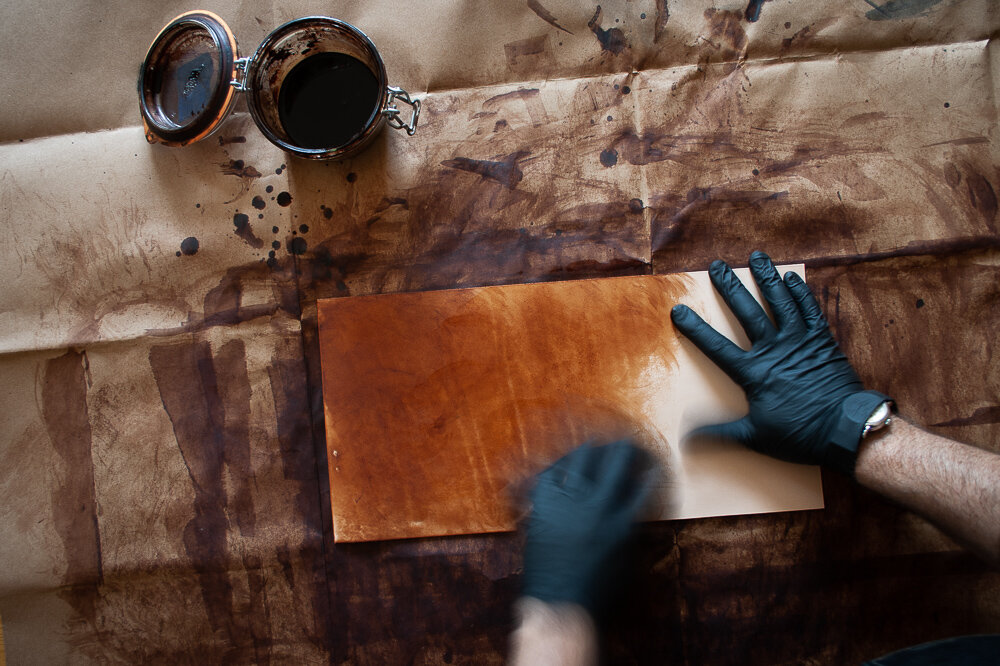
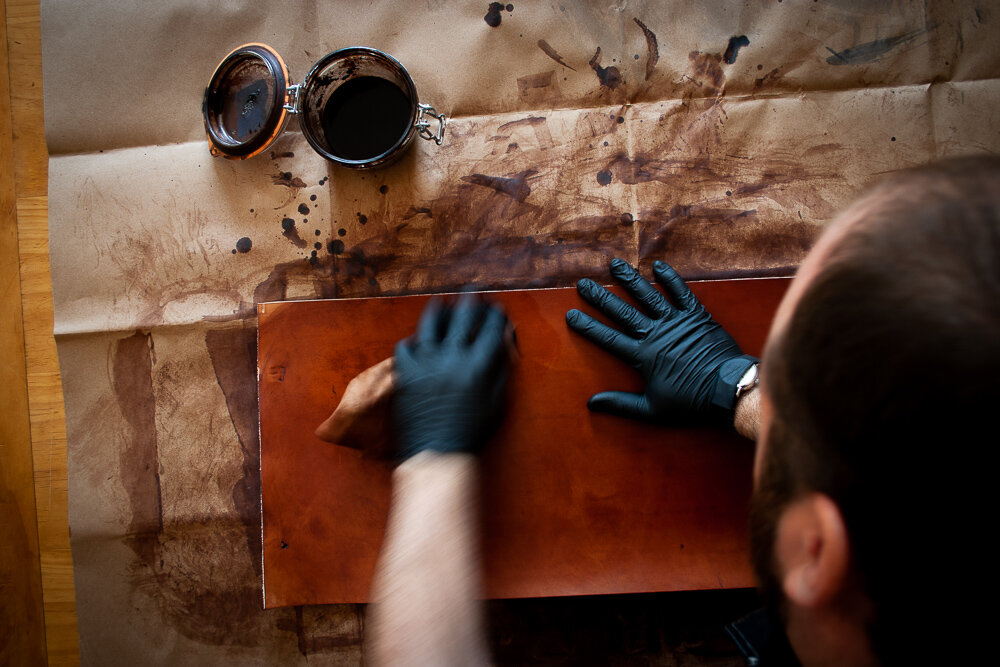
Hand dyeing.

I started Wright & Rede with $150.00 I had set aside from my tips waiting tables in a restaurant. In the early days I had to be creative with how I spent that money.

Leather is typically sold by the side (half a cow). On average that’s 20 square feet and can cost between $100-$300. So in the beginning my $150 would buy me one side, which meant one color of leather at a time.

I realized that if I purchased un-dyed leather I could have all the colors I wanted if I dyed it myself. Problem solved. I soon discovered that hand dyeing is an art form in itself. There is a reason large scale tanneries do it with sprayers or in vats.

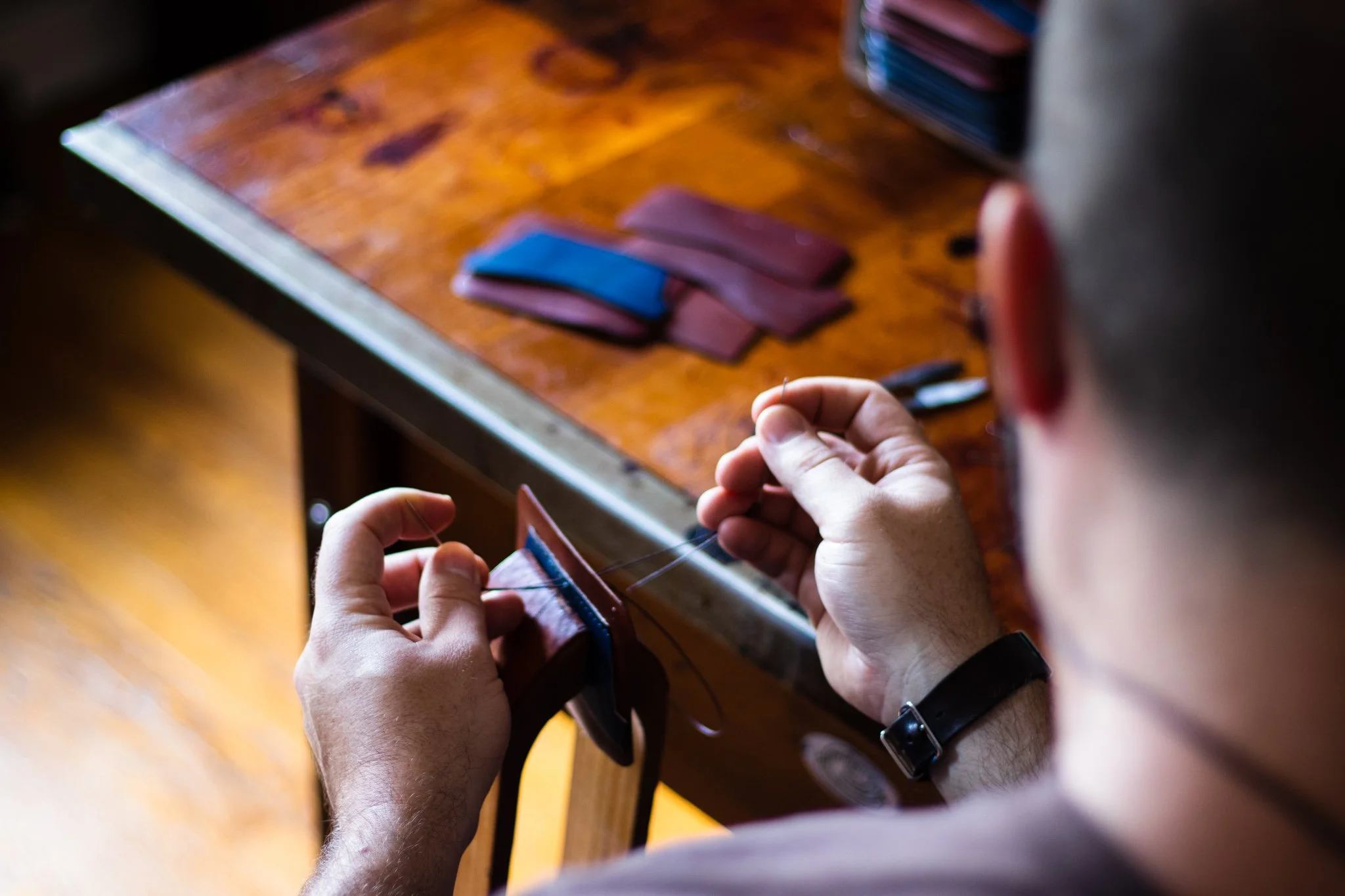
I’d describe hand dyeing as similar to watercolor painting. I have a rag loaded with wet dye. The first place I set it down on the leather is going to get a big dark blob. Then there will be streaks, blotches, and areas that just don’t take as much dye. It used to drive me nuts. I wanted the uniformity I saw in professionally dyed leather.

It was when I stopped looking for something that looked factory made that I really started to see the potential. I’ve always belived that the best crativity comes from limitations. So I leaned into the inconsistencies.

After eight years of practice I’ve developed a method I’m pleased with. Using heavy dilutions of dye combined with multiple passes, and some confidence with what I’m doing, I am able to produce work that is unique to me. No one will ever be able to apply dye in quite the same way. Much in the same way two painters will paint the same scene differently or that no two finger prints are the same.

As a result each and every piece I make is completely unique. What I once saw as a handicap has become something by which I define my style.

IMG_0897-2.jpg
Making a Mercer Briefcase Part 1.
Cutting out the leather.

Making a Mercer Briefcase.

Part 1.

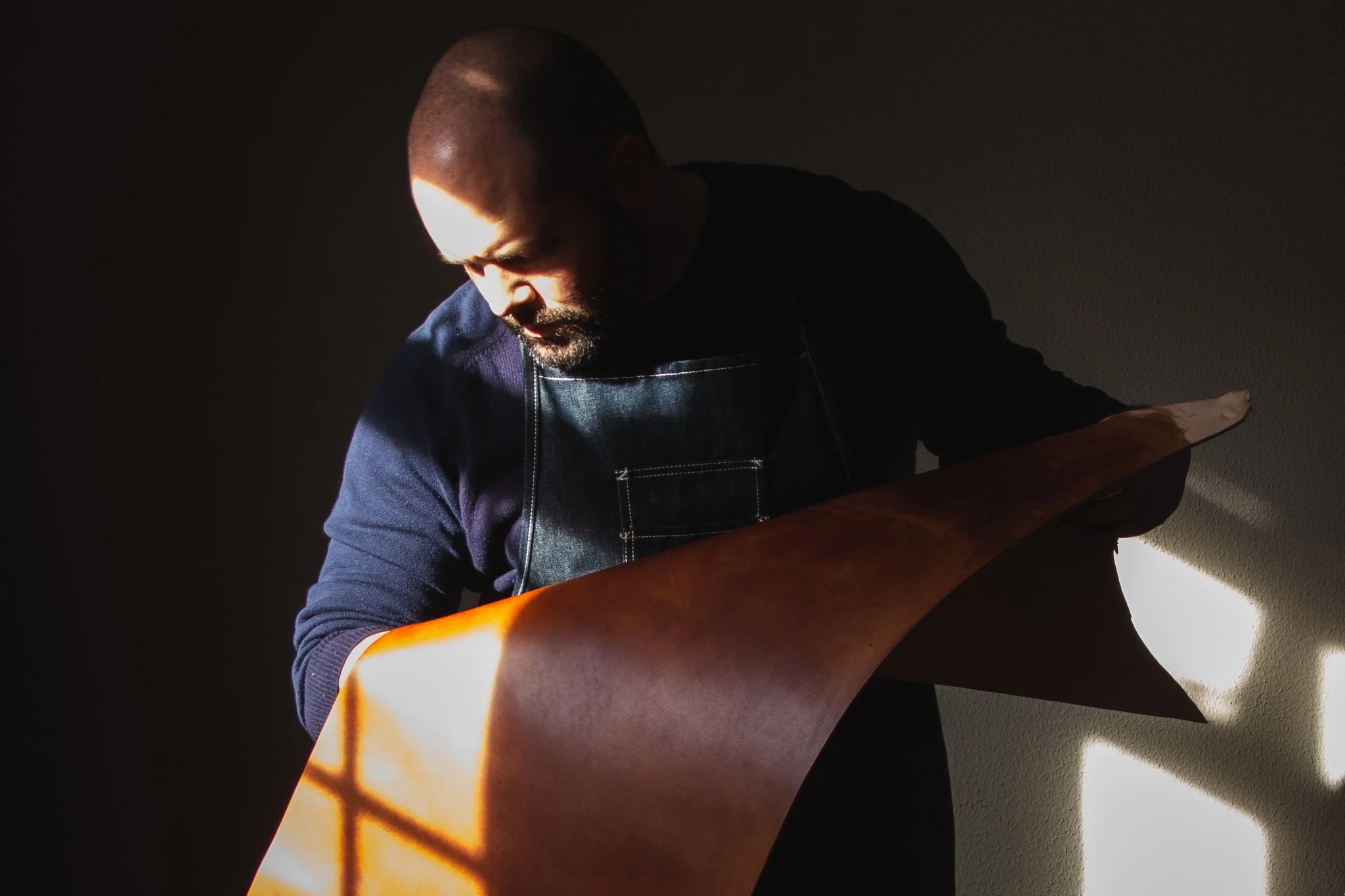
The first step to anything I make is cutting out large strips of leather.

The leather I use is vegetable tanned leather from Wickett & Craig in Pennsylvania. You’ll notice the leather is un-dyed at this point.

Using a very sharp clicking knife, I’ll cut a section of leather that is slightly larger than what I need. After the leather dries from the next step, dyeing and currying, the leather will shrink a little.

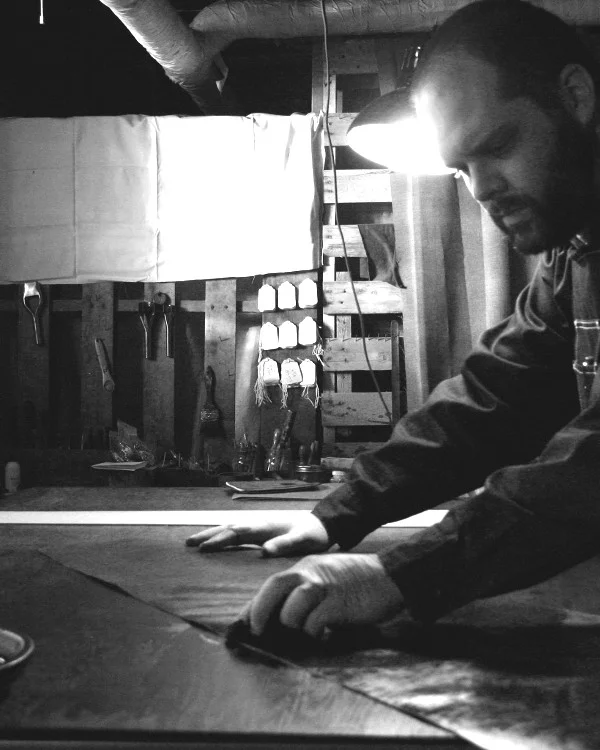
The templates set out on the leather. I’ll spend a few minutes looking at the grain and surface marks on the hide to decide if there is anything I want to avoid or highlight.

The templates set out on the leather. I’ll spend a few minutes looking at the grain and surface marks on the hide to decide if there is anything I want to avoid or highlight.

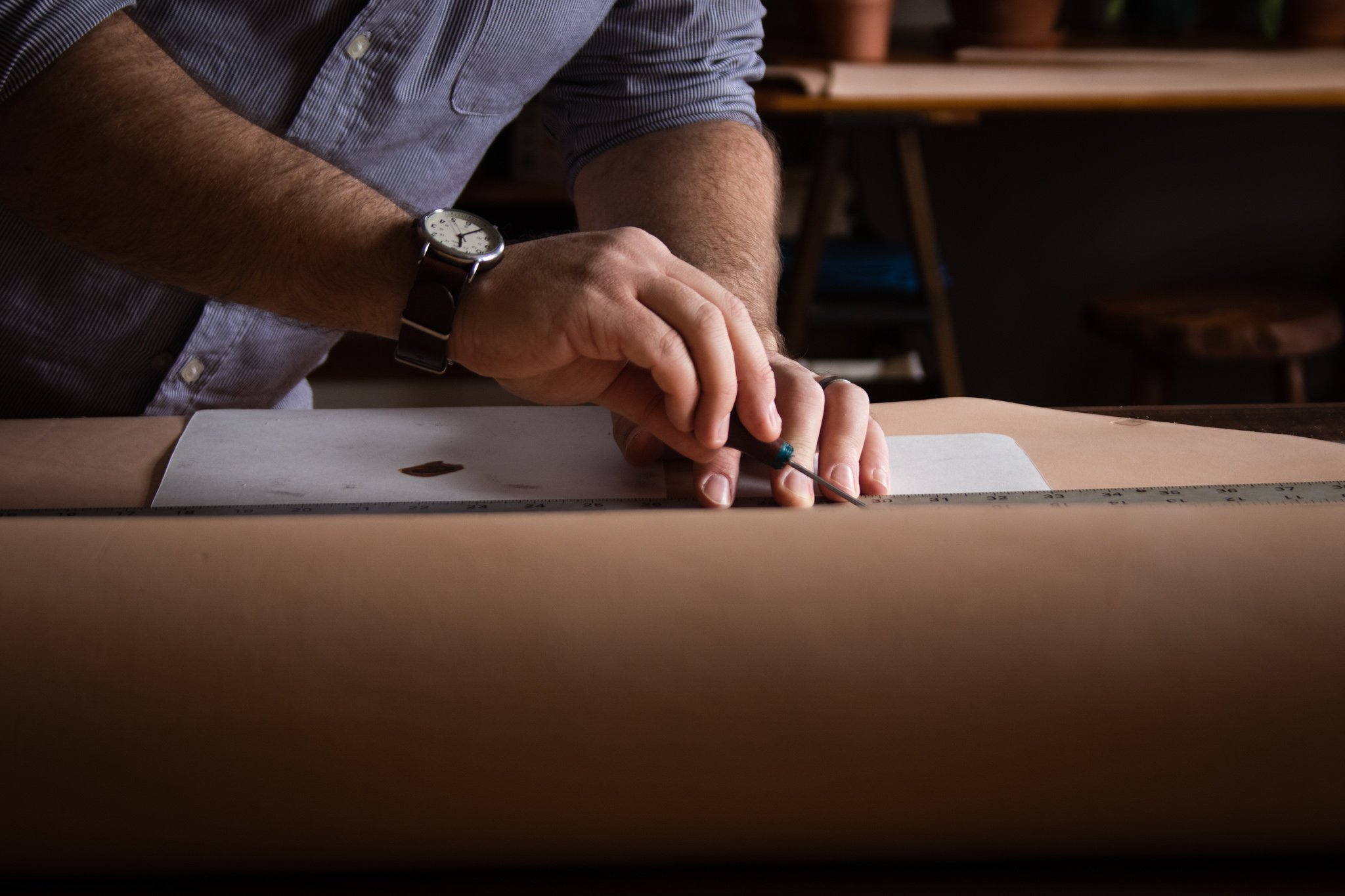
Once I have my templates where I want them, I will take a straight edge and use a scratch awl to make a light line along where I want to cut. I’ll then go back over that line with a heavier stroke with the awl. This creates a little groove for the knife to ride in when I make the final cut.

All cutting is done with a sharp blade. I keep a strop on hand to make sure. I’ll remove the straight edge, set the knife in the cut line, and cut it free hand. With the groove from the awl there aren’t any wandering cuts.

The last pass with a sharp clicking knife.

All that is left in this step is to make a note on the back of each strip to let me know what they are and what color. Then its onto dyeing and currying.

Jordan LeeComment
Making a Template for a Leather Messenger Bag
Making templates for the messenger bag.

Template Making

A Daily Dispatch

Finalizing a design is something I’m notorious for. There is always one little tweak to get in before it’s done. Then another….

I’ve offered the Mercer briefcase for a couple of years now. I’m a bit embarrassed to admit that up until now I’ve been making them by reconstructing them from my notes and taking measurements off mine when the notes fail me. It’s no way to act like a professional.

The actual process of template making is very satisfying. It’s the termination of the design process where everything comes together and gets a little polish. Once a nice, crisp template is finished on the bench I can finally start to let go of the project a little.

I have a few rules for making a template:

  1. Never assume anything is a 90* angle or square. Start by making two sides at 90* to each other.

  2. Once you have your squared sides EVERYTHING gets measured from those sides.

  3. Templates are marked in pencil. When the template is complete I’ll go back over the marks with a Micron.

  4. Any holes that need to be punched will get a red X over them.

  5. Notes about things to look out for or mistakes to not repeat get written in pencil in the middle of the template and will be added to as things evolve.

  6. Take pictures of the finished template when it’s done.

The first time through with a new template I’ll open a word doc and write out all the steps I’m taking. I’ll go back and edit this every time I make that design. The benefits of doing it this way are threefold.

I’ll pay much closer attention to what I’m doing. I’ll be less likely to repeat any mistakes. If I ever need someone else to make this bag I’ll have the instructions on hand.

Finally, snacks. Studio snacks are key.

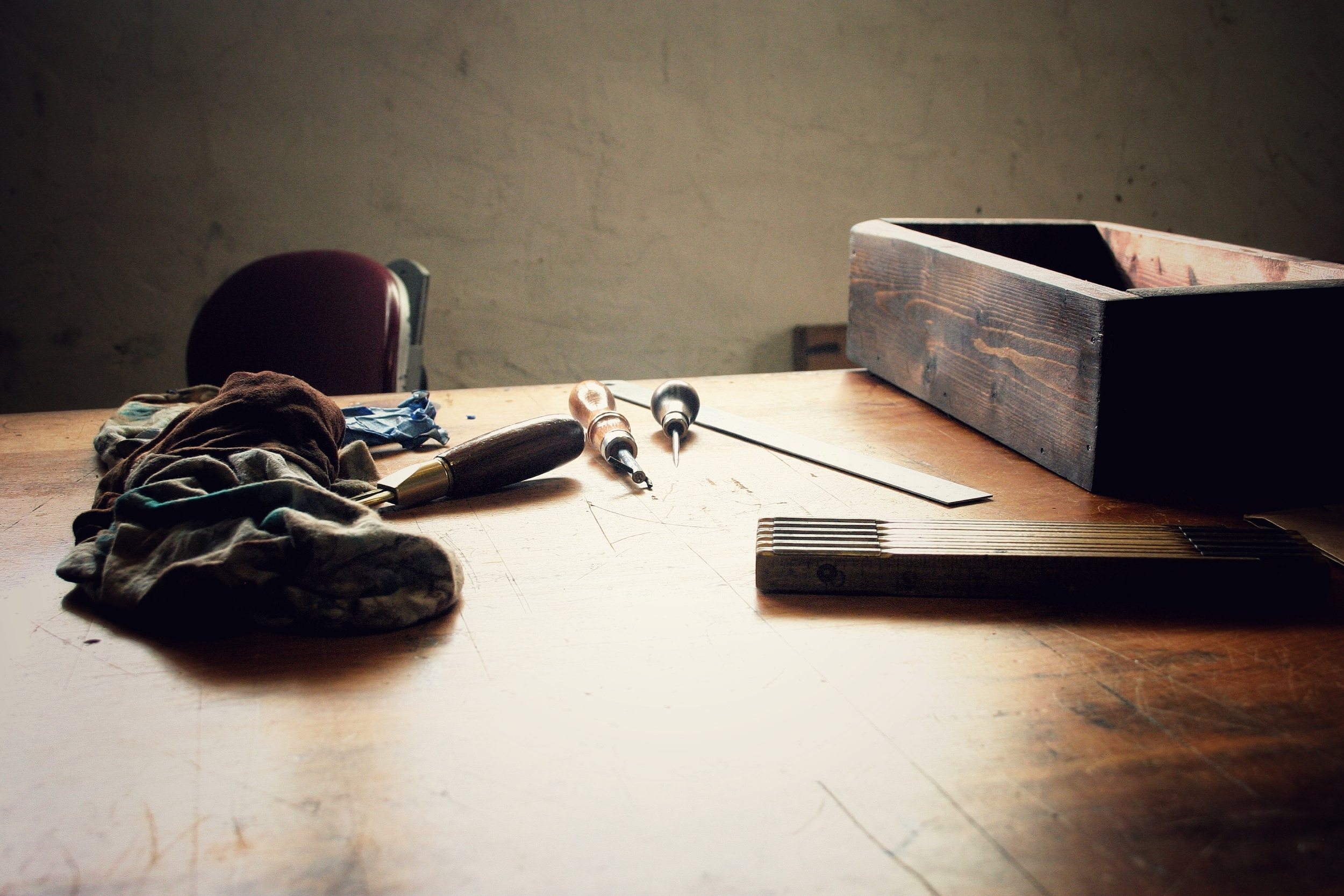
My custom and housemade scratch awl and a bowl of pretzels.

My custom and housemade scratch awl and a bowl of pretzels.

Jordan LeeComment
Meet the Hillard Front Pocket Wallet
The Hillard Front Pocket Wallet

Say hello to my little friend. 


Meet the Hillard Front Pocket Wallet. 


-- HILLARD A roofer; a tiler or slater.


This was the most requested design I don't make. To be honest I refused to make them for a long time. It's a very popular style of wallet but I never felt they worked very well. I've tried them in the past and discovered that once you fill the pockets on the outside with cards it's nearly impossible to get anything in or out of the center pocket. And that's really annoying.

 The answer turned out to be a simple redesign. One side of the wallet is left open halfway down the side. This allows for the wallet to expand while still leaving the center pocket accessible.

The divided seam for easy access.

The real test was seeing if that would make the center loose enough that things could fall out. I ran a test by leaving the exterior pockets empty, placing a single business card inside, turning it upside-down, and shaking the hopes and dreams out of it. Worked like a charm.

The fully stitched side held the card in place regardless of what I subjected it to. The result is a super slim wallet with easily accessible slots for cards and cash that fits perfectly in a front pocket (or sure a back pocket, suit jacket pocket, loose in a tote if you want to be a rebel). 

Why call it the Hillard? If you turn it upside-down I think the pockets look like roof shingles. There is a method to my madness. 

Don't Measure Yourself By Other Success

I heard a great bit of advice yesterday. "When you look back at your life, your defining moments will not be your greatest hits, but the times you were knocked down and defeated and felt like giving up but didn't." I have been in business for myself for six years. There are forty-three marks on a six year old piece of scrap leather I keep in the workshop that reads "Starting a business freak outs." Each one is a moment when I was ready to give up. A moment where I didn't know why I should bother, or got overwhelmed with not knowing what I was doing, or a surprise bill came in I didn't know how I was going to pay, or I felt embarassed/guilty/stupid/useless. Forty three times I was ready to walk away. But I didn't. It is easy to slip into the habit of measuring yourself by other people’s successes. But that is only part of their story too. A very small part at that. It doesn't matter if you win every battle. You only have to win more than you lose. The only way that is going to happen is if you keep showing up to the fight.

Jordan LeeComment
Space for Silence

Being a small business owner in the world of social media is a strange thing. At one point in time you were just a florist or a sign painter. Now you have to be florist/photojournalist or painter/photojournalist. It makes me wonder about all the great work out there I’ll never see because the artist doesn’t know how to speak the social media language. I often struggle with posting on here. I don’t want to flood your feed with “here’s my product do you want to buy it?” but often I just don’t have anything interesting to say. I think it is important to get some quiet in your head. Not just from the noise around you but also your own internal noise. How many things have you heard today that we’re really worth listening to? How much was just noise?

Jordan LeeComment
Lose Yourself In the Process. Find Yourself in the Art.

I grew up and live in the rust belt. Utilitarianism is our bread and butter. It’s ultimately why I gave up on a Fine Arts career. I couldn’t wrap my head around the value of art. You can’t eat it. You mostly can’t sleep under it, or wrap yourself up for warmth. What’s the actual point? “It looks nice.” was too hard of a pill for me to swallow. It’s funny to me that now through my craftsmanship I’m working my way backwards to the answer. If you are looking for a purely utilitarian wallet, make one out of duct tape. But somewhere inside I know there is something more important that pure utility. Yes, it should have to work well, but it has to do something more to be of value. It should make you feel good when you touch it. Or become a small part of how you identify yourself. I think that might hint at the utility of Art. You can look at something someone else made and find something of yourself in it

Jordan LeeComment
Walk, Don't Run

I start off every year by looking back at what I have learned in my previous year. I write it down so that I'll remember it when I'm neck deep in work and too busy to think. The lesson I'm thinking about today will be an unpopular one, but one I have given a lot to learn. The Hustle, and the lifestyle that we small business owners proselytize about, is a myth and if you are not careful it will kill you.

In our culture we have this ideal image of the independent business owner giving it all to succeed. It's part of the story we tell. The long hours, the late nights, the stacks (finished and unfinished) of work that we use to prove how busy, and thus successful, we are. I'm guilty of it too.  A month ago I was bragging about working at least 12 hours a day 7 days a week to keep up. Your see it in credit card commercials, blog posts, and Instagram. We make insider jokes about it to each other. In fact I just noticed I did it in the first paragraph of this post. Really though, we are all just helping perpetuate what is ultimately a perversion of the great American Dream. If you try hard enough, and are willing to work for it, you will succeed.

The problem with that ideal is what happens on the flip side when your feet actually hit the pavement. If by working hard you can succeed then if you are not succeeding you are not working hard enough.

When you are your own boss success is murky at best. I can attest, and anyone I have asked has agreed, that you never reach an end point. You never get to a point where you've had enough. There is no peak to stand on and look back on your accomplishments from. We are business owners. We are Hustlers. There is always another peak.

When you tether your success to your effort the problems that you create become manifold. The truth is that effort doesn't equal success. Some people are born to rich parents who will bank roll their business. Some people ooze social grace and will succeed based off their ability to network even if they make shit work. Some people are just stupid lucky. For most of us the best way to get ahead is by throwing a bunch of effort behind it. The creates a problem similar to the race to the bottom-line we see with large corporations. If you can make it cheaper than your competitor then you win. So you end up with a bunch of cheap stuff. With small business owners this is a race to out work each other. It's called the Hustle. If you work 15 hour days and I work 16 hour days then I win. Instead of crappy imported goods you end up with crappy over worked business owners.

So who cares if I work hard? It's my choice, right? Here is why it matters. You are only human. You live in a physical body. A body that needs sleep, and food, and social interaction, and rest, and to be able to set down burdens, and to live life and experience the world that you only get the one chance to be a part of. If you ignore these things for too long it will really and actually kill you. This problem is compounded by the fact that you can't come up with good ideas when you are tired. You can't give good customer service when your are pissed off. You make mistakes when you are distracted. You end up trading away the days at the end of your life for some hours poorly spent in the middle. Sooner or later the one will catch up to the other.

So what do you want me to do about it, Jordan?!? Stop. Just stop. Don't buy into the Hustle. Start by sitting down and defining success. Define it in real terms. Something check-listable. An end point. Then take a good look at what you really have to do to get there and decide if its worth it. Reassess on a regular basis to see if you are getting there and what it is costing you to get there. Be ready to fail. Not in the positive "fail upwards" and learn from your mistakes fail. I'm talking about the ugly someone-else-won-by-being-shitty-and-undeserving kind of fail. That's going to happen and it's okay. You are human. Take it on the chin, and then go home and play with your kids, take a walk in a park, drink a beer and catch a fish while watching the sun set. For the love of God don't post about it. Stop selling. Stop working. Drink it in. When you look back on all of your days let them be filled with moments of a life well lived. Life is about the journey not the destination. You can take life at a stroll and savor every step, or you can hustle through it. The choice is yours.

What's playing in the workshop?

I have a long history of listening to audiobooks. What started has a habit during my morning commute has followed me into the workshop. Recently that habit has transitioned into listening to podcasts while I work. I'll be honest, I'm really not a big fan of the listening-to-two-strangers-yammer-on (get to the point already) format you often hear, but the revived tradition of radio drama is really appealing to me. So I've compiled a list of some of my favorites for you to check out.


The Black Tapes

Spooky! If the hosts of NPR were to join the X Files. The first podcast I really got into. Join Alex Regan has she she explores the paranomal and tries to unravel the mysteries of the Black Tapes.


Lore

" Because sometimes the truth is more frightening than fiction. "

Author Aaron Mahnke explores to dark sides of our history. Ghouls in Irish graveyards, globe trotting serial killers, the monsters inside us all. It's all here and all true.


LifeAfter

A new podcast about what happens to our social media presence after we die. A really outstanding cast of actors and a great plot had me finding busy work around the workshop just so I could stay and listen to another episode.

Reply All

Not an audio drama but one of my favorites. Alex and PJ are like the Lewis and Clark of the internet. They explore the weird and mysterious while producing a show that is a lot of fun to listen to.

Maker's Broadcast

The newest podcast on the list. At the time of writing there are only two episodes released. Each episode features a visit to the workshop of a maker in England. There is no narration, music, or ads. Just one person talking about their work and why they do what they do.

Jordan LeeComment
What's Playing in the Workshop

Kick out the jams and dance like you know what you're doing.

Sometime around puberty I felt the need to add a soundtrack to my life. Music has been a constant companion for me ever since. These days it's more Raffi than Radiohead, but one of my favorite parts of the day is stepping into the workshop and losing myself in my work while bobbing my head along (and occasionally singing poorly) with my current playlist.

Jordan LeeComment
The Downside of Aspirational Living

Can we just talk about this for a minute. During a recent conversation with a good friend about marketing yourself as a small business I was given the well intentioned advice that I need to sell an aspirational lifestyle. I've thought about it a lot. I just don't think I can swing it. Here is the truth of it. This is the first fancy latte I've ever ordered. It got cold while I took pictures of it. I'm only sitting in this coffee shop because I'm meeting a customer that wants this knife. I was up until 1:30 last night trying to figure out what a media kit is and how to make one. Then my website went down and I lost what progress I had made. I'll be up until 1:30 tonight to try to fix it. I'll get up 5 hours later to take care of my son for the day. I'm not complaining. I'm just trying to point out that my life is just as good/crappy as yours. The flip side is that someone is about to pay me actual money for doing what I love. All this aspirational living is bringing everyone down if you ask me. It's good to want to aspire to more, but don't let the coffee get cold in the meantime.

Jordan LeeComment
The Little Moments

It is the little moments in a journey that can define it for you. When I was 24 I went to visit my family living in Ireland. Last night over dinner we were talking about our favorite memories made there. For me it was smoked salmon, raw onion, and fresh sweet butter on a slab of brown bread. I had just gotten off the plane and we had stopped at a pub for a bite to eat. It was around 5 o'clock in the evening on a cold, wet day in February. As we walked up the hill to the pub the air started to smell like peat smoke as people got home from work and started to warm their houses. Every time I smell chimney smoke or sip on a little smokey whiskey I'm standing outside that pub, smelling the warm fires of home and about to eat one of the best meals I've ever had.

Jordan LeeComment
Bravery, Aspirations, and Noise

You can spend your time getting 10,000 new followers or getting one of them to buy something. 

One is about business while one is about your insecurities. One is about aspirations, market positioning, and status. The other is an actual result. One is about possibilities the other is what is possible. A business is a means of being paid for your work. You can't pay your rent in Likes.

Jordan LeeComment
Go Quote Yourself

I was followed by a new business on Instagram yesterday. I checked them out to see what their story was. When I looked at their profile I saw that they were a new leather goods lifestyle brand. They had been around 6 weeks or so. The had 42 posts. 3 of which were their own pictures. I think the regram will be the nail in the coffin for Instagram. It was the only social media platform where you were required to share new material. Pinterest and Tumblr have become about curating existing material. Facebook and Twitter have the share and the RT. 

This got me thinking about the scarcity of original material out there. It's time we spend less effort curating and more creating. Create something to be shared. It doesn't have to be groundbreaking or entirely new. It doesn't even have to be that great. This post isn't the best ever written. It will be ingonored or forgotten by most who read it. Some little part of it will stick with someone though. 

Put something out there. A new picture, sentence, thought, anything. Some point to be referenced later, even if it is only by you. Become quotable.

Jordan Lee Comment
Stand in the Place Where You Live

It started with tote bags. Or was it German hand-planes? I don't remember. There was this sneaking bit of discomfort that I found lurking in the dusty corners of Instagram. A seething Mathmos clinging to all of my Pinterests. This gray sameness. No wait, it started with beer... If you are a beer drinker in this modern age I'm sure you have encountered it. A new local brewery opens up in your town. You stick your nose in, hoping that they've got something good on tap, and suddenly you have a moment of déjà vu. Your eyes glide down the beer list. The super hoppy IPAs. The token porter or stout. A wheat. Something else that is really just another IPA, but with a different name. Maybe a Belgian or two. A Black IPA or Session Ale so that you know how cutting edge they are. There it is. The sameness. The fact of the matter is that this small town brewery could be anywhere.

So what does any of this have to do with running a business? Go to Etsy and you will see what I'm talking about. Log on to the websites of a few different independent leather goods makers. Do they have a key ring? A minimalist card wallet? How about a tote bag? Are any of them really all that different from each other? Does the guy in Utah produce anything that different from the guy in Texas? Is there a Houston style of making things?

In the world of modern communication creativity has gone viral. All at once everyone's good ideas became accessible to everyone else. Contrary to what you might expect this has really stifled ingenuity. Because now when you start a leather goods business (or graphic design, ice cream, jewelry, food truck, wooden furniture....) and you want to make a tote bag, you log on and search for images of tote bags. Now you know how to make a tote bag. You will have a tote bag just like everyone else except yours will be, you know... different (special/unique/artisanal/rugged/folksy/please-buy-my-bag).

My point is this, once upon a time there was a bookkeeper in England. Every day he had to lug the day's ledgers from his client's office to his. He needed something to carry them him. So he had a local leather maker make him something that would hold English style ledgers. Elsewhere in the world there was a rice framer in Vietnam. She needed a way to get the rice to the warehouse so she made a reed bag to carry it. At the same time a young Shawnee was fashioning a deer skin sack to hang from his belt to hold his fire starting materials. All of these folks used what was available in their region (materials, knowledge, demand) to craft something they needed. These became archetypal trends and now we have tote bags, bucket bags, and possibles bags.

Start by solving a problem. If you have a brewery you don't have to have an IPA. If you are a brewery in Cleveland make a beer that goes with pierogi, or to pair with a local cheese business, or really good plain English ale (seriously, someone do this). If you make jewelry you don't have to make geometric frames and half-dip them in pastel paint. Make jewelry that you can wear while shoveling snow. For God's sake stop drawing bison (or stags or arrows) in chalk on things for people's logos. If you are going to make a tote bag don't start by looking at what everyone else has made. Start by thinking about what needs to be carried around and build a bag around it. Clevelanders carry different things in their bags than people in L.A. Walk down the street and look for inspiration when working on your graphic design. When you shrink the vast world of possibilities down to the world around you, you begin to create new possibilities by limiting yourself.

How Much is Your Time Worth


If you are starting an independent business one of the most valuable productivity tools you can develop is an accurate hourly rate. Not only will it help you establish a proper price for your goods or services but it will also help you figure out how to best prioritize your time.
So what should your hourly rate be? That is something you will have to figure out on your own, but here are some helpful guidelines. Do you need specialized equipment? Did you have to learn how to operate that equipment? Did you go to school or have to study to acquire your skill set? Are you proficient? Do you provide a level of service that goes above the standard? If you could answer yes to most of these questions then you qualify as a tradesman. You studied to use a specific set of tools and skills that apply specifically to your field. So if you need a starting point think about what your mechanic/plumber/electrician/web-designer charges for labor. Then comes the big debate and a little honesty. Are you a novice at your trade? Do you work at or above the level of your peers in your trade? How much overhead is required for you to do your job (overhead = cost of rent, insurance, equipment, packaging materials, branding... anything you have to pay for that doesn't directly go into the product you are making). Adjust your rate accordingly. This is not set in stone either. Hopefully you are getting better as you gain experience and your rate should reflect that. This also assumes that you are selling all that you make. If you are making a bunch stuff that isn't getting sold you need to reexamine your product and pricing (to be covered in a later post).


So now you have come up with a number. Great, you made up an imaginary number. What do you do with it? Your hourly rate can be used as the fixed variable in any number of situations. It's the difference between a+b=50 and a+25=50.


Here are some examples. For arguments sake let's say that you set your rate at $30 per hour. Say you need to order some supplies. You find them online but shipping is $12. You can go pick up the supplies from a specialty store on the other side of town and save on shipping. It takes you 1.5 hours to drive to the store and back. You just saved $12. What if you had just stayed in your workshop and had it shipped? In 1.5 hours you should have been able to produce at least $45 worth of labor towards your product. So by driving to the store to save on shipping you are actually losing $33.


Here is another good one, and a pill that most of us really need to swallow. You need to update your website. Nothing complicated, you just need to update your product listings and event schedule. So you spend the day fixing up your website because you are a boot-strapper and you wear all the hats in you business. At the end of the day you spent 8 hours getting everything sorted out. Had you spent that time in your workshop you could have produced $240 worth of labor. That is a ton to spend on such a simple task. Had you paid a friend or freelancer to do it (at $15/hr) you would have ended the day ahead $120 and not spent the day zonked out in front of a computer screen.  Had you hired someone that knows what they are doing they will also get the job done in less time so your profit would have been greater.
Knowing your hourly rate is also useful when pricing your work and when collaborating with others. Let's say a couple asked you to make a bench out of a tree that fell in their backyard. What do you charge in a situation like that? If you priced your goods based on cost of materials you would be working for free. If you set your prices based on gut feelings (it happens a lot) you would have to try to figure out how much you might sell a bench like that for and then go from there. If you know your hourly rate to be $30 per hour and it's going to take you 20 hours to make the bench then the bench costs at least $600.


Having a solid hourly rate can be used in a myriad of other situations. What price you charge for your final products, what products are worth producing, when to hire employees and how much to pay them, and when to invest in equipment just to name a few. Also, being able to assign a value to your time can provide you with a little bit more confidence and a little solid footing in a your decisions as a business owner. A position that frequently calls on you to make choices based on your gut.
 

Jordan LeeComment
Unfollow Your Dreams

Finding the right kind of inspiration can be tricky. After years of thorough investigation I have concluded that the worst place to go looking for it is on the Internet. If you want true inspiration stop looking at the work of your peers. Do it right now. Log into your social media accounts and unfollow anyone working in your medium. Why? Because what you are gleaning from them isn't inspiration, or at least it's not your inspiration.


You know how when you get a paper cut and it hurts for a minute but then you don't feel it anymore? I think inspiration works the same way, that little paper cut is sending information to your brain over and over again until your brain is like "Yeah, I get it. Shut up".  If you are constantly bombarding your brain with other people's signals then your own will get lost.

So a few weeks ago I did a little inspirational detox. I unfollowed everyone that works in my medium (I left a few that I enjoy reading because of the material they post not their work). I stopped reading the product catalogs that arrive at my door step. In general I have dropped out of the community around my medium. The result is that I'm coming up with my own answers and better ones at that. Inspiration is not Plug-and-Play. So stop taking a little bit from here and a little bit from there. Cut down on the noise so you can hear your own voice. 
 

Jordan Lee Comment
The Only Answer That Matters

I was at a large family gathering over the weekend. While sitting around and talking about life in general one of my in-laws asked what was the hardest part about running my business. I thought about it. My response was "deciding to keep doing it every day." I could see the look of confusion cross their face. Why not production, time management, budgeting, advertising, or something more mundane? What do you mean deciding to keep doing it every day? Does your job suck that bad? Your business must not being doing so well.

My father has a saying. "Working for yourself is easy. One day you get out of bed and decide to not go work for any one else. The hard part is that every day after that you have to get out of bed and decide to not go work for any one else."

Production times get better as I do. Time management is something that will sort itself out. Budgeting and advertising are all problems that can be solved. The plague of questioning yourself is something that will never go away. Am I doing the right thing? Is this worth it? Wouldn't it be easier to just get a normal job? Should I feel guilty for not just going with the flow? Could I be doing better?

I love my job. I love what I have done so far. I love all the possibilities it presents for the future. I also have days where I wake up and think, "am I really going to do this again today?"

When you are your own boss you have to learn to be your own cheerleader. You have to learn when to give yourself a break or cut yourself some slack. You have to learn how to keep going. You have to learn to remind yourself that today you took a step forward from yesterday. Tomorrow you will take the next step forward again. Every morning when I wake up my business is failing until I get up and get it working. I have to ask myself, "am I really going to do this again?" Then I get up and do my best to make sure that when I have to ask myself that question again tomorrow I can think "Look at what you did yesterday. What can you do today?" Because if you are your business then without you there is no business. Take pride in your work and keep one eye on tomorrow. The future is filled with uncertainty and questions with out clear solutions.  The only real answer is, "Yes, I'll try again today."

Why Buy Local (No Really)

I get to hear a lot of justifications about why people should "Buy Local".  Some of them are actually quite good. Tax revenue, keeping money in your neighborhood, supporting a growing community. Sometimes it's just a bullshit reason to drive up the price of something. Let's be real here, I love to support local businesses, but I don't think that the $7 I just spent on some fancy cheese is going to repave the potholes out front. I am notoriously practical and I have a slightly different view on why someone should make their purchases from a local business. Let's start with the total opposite. You know those late night ads you see on TV? The ones for the kitchen gadget that can deep fry a turkey and then turn it into a low calorie smoothie that the whole family will enjoy? Do you know what their business plan is? To successfully sell a product. Think about that sentence. They don't have to sell a successful product. It doesn't have to be well made. This is because they know a few things about you. A) If you buy their patented Turkey Smoother you will only ever need to buy one. B) If you buy the Turkey Smoother and hate it, statistically, you will not go through the hassle of returning it. C) You will realize the pointlessness of a Turkey Smoother after the return period has expired. They don't need to sell you five Turkey Smoothers. Just one. They don't care if you ever buy from them again.

Let's look at my business plan. My reach is not global. My reach is local. My reach is about as far as I can stick my hand out to shake yours. That is how I met most of you. I handed you my card. You have a friend that knows me. I was recommended to you by someone else. If my plan was to just sell one thing to each person I met  I'd be out of business in a year. By staying a local business I am holding myself accountable to those in my locality. This is because I can't afford to loose customers. I have to make a product that you are happy with. I have to make something so good that the kid bagging your groceries asks where you got it. I have to make something so good that you will tell him. That you will remember my name. That you will come back and buy again. That you will bring your friends with you when you do.

So that is why I buy local. It's not just to add to the revenue stream of a local community. It's because I know that the person I'm buying from really cares about what they are making. They care because they have to. They care because they want to still be selling them next year.